Week 1 Q & A

Number of replies: 35

Do you have questions about this week's content? Post them here to get the answers!

If you want to know when a new post has come in, subscribe to the Forum and you will get an email to let you know. The Subscribe button is on the upper right (had to check my hands :)) You need to do this for each forum (and there are 2 per week)

Also, you can choose to see questions and answers in various orders/forms - oldest first, nested, etc. The box to choose is on the upper left.

To Post Your Question:

Click on Reply and type your response in the text box. To post an image click on the Advanced link and then click on the image icon in the tool bar at the top of the text box. To post an attachment, click on the Advanced link and drag and drop your file in the attachment box. Click on Post to forum to submit your question or reply.


In reply to First post

Re: Week 1 Q & A

by Amy Howansky -
Hi,

After reading the course materials and watching the videos, I understand the overall, basic concept of economic injury level (EIL) and economic threshold (ET), but I am having a harder time understanding the subtleties of when certain influences make the EIL go up or down when the influences go up or down.

Thank you for your help.
Amy Howansky
In reply to Amy Howansky

Re: Week 1 Q & A

by John Sanderson -
Great question, Amy. For greenhouse ornamentals, there are almost no ET’s or EIL’s that have been scientifically established for any pest on any crop, unlike the situation on many outdoor agricultural crops such as corn or apples. There is simply far too many differences among greenhouses, crops, crop mixes within the same greenhouse, where the crop is in its growth cycle, market sales values, geographic regions, etc., for anyone to establish a true EIL that would be appropriate for any pest for any grower on any crop in any greenhouse. So, for example, it doesn’t work to suggest that everyone needs to spray whenever you reach an average of, say, 2.28 thrips per sticky trap. For some growers, such an EIL would be way too low, and for others, way too high. It all depends on the situation for each grower.

This is why we suggest that growers must establish their own EIL that works for them under their own circumstances. We call these “site-based thresholds”. Very, very briefly, here is generally how it works:

Soon we’ll be discussing ways to record and keep records of pest levels in a given greenhouse. At some point, a grower observes some level of a given pest that makes her/him decide that a spray is needed. This level may be very different for each grower for all the reasons mentioned above. But this pest level can suffice as an initial EIL for that crop in that greenhouse at that time for that grower. With continued regular scouting s/he can then record whether the spray (or biocontrol agent) was effective to reduce the pest level to a tolerable level for that grower. (Btw, it’s a fallacy to assume that insecticides/miticides can completely and economically eradicate a pest on a crop). Over time, the grower can fine tune this EIL by referring to the scouting records, which include the control actions used and pest levels that resulted. This is why record-keeping is so important.
In reply to Amy Howansky

Re: Week 1 Q & A

by Elise Schillo-Lobdell -
In addition to the points that John made I would also add that the tolerance threshold for a particular pest can change over the course of a crop. The same average number of fungus gnats per sticky card could cause much more damage to very young seedlings than to the same plants when they are mature and headed out the door. Elise
In reply to First post

Re: Week 1 Q & A

by Ana Gourlay -
Hi,
It was recommended that the sticky cards could be attached to a bamboo stake. Is there any risk of the hollow stick with a somewhat permeable surface becoming a host spot for pests and disease? I'm assuming they should not be re-used (i.e. moved into another plant's soil). Is that correct? If you are using metal stakes, would a wipe with a 10:1 water to bleach ratio be enough to sterilize them or should they be soaked? Thank you.
In reply to Ana Gourlay

Re: Week 1 Q & A

by Elise Schillo-Lobdell -

Hi Ana, I am so happy you asked that question.  Ideally you should try to attach your sticky cards to the greenhouse structure if at all possible (you can see examples of hangers from hanging baskets used for this in some of my video clips), but it’s not always possible and doesn’t work where there are automatic watering booms.  I have only had one case of bamboo stakes actually being the host spot for pests - some lovely little bright green beetles made a complete mess of a poinsettia crop after they chewed the stakes (used to tie up the poinsettias) to sawdust.  I do believe it is probably possible to spread disease organisms from one pot to the next - you might notice in one of my video clips that I turn the stake upside down before putting it in a different pot.  I also avoid putting stakes in any pots where the plants are not healthy.  You could be very proactive and make some small permanent stands (made cement in a plastic cup?) for your stakes, or, as you said, use metal stakes and wipe them down.  Anyone else have any suggestions on ways to avoid having your stakes be a source of problems?   Elise

In reply to First post

Re: Week 1 Q & A

by Joseph Moreno -
Hello! I remember that you mentioned that when checking for thrips it's best to use the blue sticky card. Why is it better to use the blue one instead of the yellow one for thrips but better to use the yellow one for fungus gnats and shore flys?
In reply to Joseph Moreno

Re: Week 1 Q & A

by Elise Schillo-Lobdell -
Thrips tend to be attracted to blue more than yellow, but you will still catch plenty of thrips on the yellow cards - and it’s easier to ‘read’ the yellow cards than the blue - so - in my opinion - you are better off using yellow cards for monitoring (i.e. doing your weekly pest counts), and just using blue cards to do mass trapping in crops that you know are particularly vulnerable to thrips issues or that always arrive with thrips (spikes, sweet potato vines, verbenas, etc.). You can set up your own experiment - see what color attracts more pests in your greenhouse and which is easier for you to actually use. There are also white and black cards available now, in case this isn’t complicated enough for you.
In reply to Elise Schillo-Lobdell

Re: Week 1 Q & A

by Elizabeth Lamb -

And there used to be hot pink!  In the updated assignment, i suggest uncovering both sides of one or more of your yellow/blue cards to compare what you catch.

In reply to Elise Schillo-Lobdell

Re: Week 1 Q & A

by John Sanderson -
I agree with Elise. My recommendation is to stick with yellow sticky traps for monitoring all flying insect pests of greenhouse crops. Though blue may be a more attractive color for Western flower thrips, it isn't THAT more attractive. Trying to keep track of pest levels on two different types of sticky traps only makes scouting more complicated and the added effort will likely not change the control decisions anyway. I recall a study that did show that blue traps detected Western flower thrips about a week earlier than yellow traps, but this did not change when the growers decided to spray.
In reply to First post

Re: Week 1 Q & A

by Tiffany Donaldson -
Hello,

I was wondering if sticky traps are an effective way to manage pests such as fungus gnats, or if it is just for monitoring purposes.

Thank you!
Tiffany D
In reply to Tiffany Donaldson

Re: Week 1 Q & A

by Elizabeth Lamb -

Tiffany,

It may depend on how many you put out and how often.  Usually if mass trapping is what is intended, larger areas of sticky material are needed - like the rolls of yellow sticky tape

From Utah State


In reply to Elizabeth Lamb

Re: Week 1 Q & A

by Elise Schillo-Lobdell -
And I would add, there are certainly easier & less messy method to deal with fungus gnats - like using nematodes and better water management, but yes, they could be used for mass trapping. Sometimes I’ve placed cards in ‘hot spots’ just to show the growers where the problem areas are - sometimes under benches to see if the fungus gnats are coming from there, but I wouldn’t include those in my regular weekly counts. I’ve even placed cards over garbage pails so the workers can see what is emerging out of there - and back onto the crops.
In reply to Elise Schillo-Lobdell

Re: Week 1 Q & A

by Sathwik Manjunath -
How would you would you prioritize to break the cycle of high fungus gnat pressure while still protecting beneficial organisms?
In reply to Sathwik Manjunath

Re: Week 1 Q & A

by Elizabeth Lamb -
Sathwik,

I would always start with cultural methods - less water in particular, checking your media to see if it is infested - and then combine them with biocontrols - nematodes are a good choice. If after doing all that you still have a high population of fungus gnats, you need to do some investigation to see if you can find out why. If you must go to pesticides, choose one with a short duration of toxicity and then come back with the biocontrols.
In reply to Sathwik Manjunath

Re: Week 1 Q & A

by John Sanderson -
Good question. There isn't space to go into a lot of detail, so here are some quick ideas. First, there are many insecticides that either do not harm beneficials, or that can be applied in a way that minimizes harm to beneficials. Some producers of beneficials have online searchable "side effects" lists that can be used to check whether a certain fungus gnat insecticide would be harmful to a given beneficial species. Koppert and BioBest both provide such lists. Second, in the case of fungus gnats, insect-killing nematodes can be very effective yet are not harmful to beneficials that do not live in the soil, nor harm most of the beneficials that do live in the soil.
In reply to Sathwik Manjunath

Re: Week 1 Q & A

by Elise Schillo-Lobdell -
And this might be a good place to let everyone know - before anyone asks - we do not give specific pesticide recommendations in this class because we have students from Texas to Prince Edward Island and from North Carolina to Michigan. You should consult with your own local Ag. agents for what pesticides are legal in your location (in New York State some products are permitted everywhere except Long Island). As for the biological controls we discuss, I believe almost all of them should be available everywhere but there are a few that are available in Canada that we don’t have yet in the U.S.
In reply to Elise Schillo-Lobdell

Re: Week 1 Q & A

by John Sanderson -
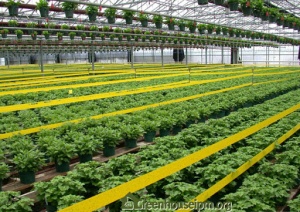
Some California growers use yellow sticky bands (like those in the photo above) but put them beneath the benches to catch fungus gnats as well as shore flies. These growers reported a 50% reduction in number of sprays where they used the sticky bands beneath the benches. Some Canadian mum growers use yellow sticky bands but put sticky bands only over mum cultivars that are particularly susceptible to thrips. Greenhouse tomato growers often use sticky bands down each row of tomatoes, placed above the top of the tomato canopy, to trap adult greenhouse whiteflies.
In reply to First post

Re: Week 1 Q & A

by Grace Harper -
Hi! I found this whole section very interesting, especially about the two different catagories of root rot. My question is, for the true fungus root rots, can a preventative be put in the soil before planting plugs that are more susceptible than others?
In reply to Grace Harper

Re: Week 1 Q & A

by Elizabeth Lamb -

Grace, I will let Margery give you a better answer, but there are products like Rootshield that contain Trichoderma that can be applied to soil at planting or transplanting that have some activity against the root rot fungi, i believe.  And i think there are soilless mixes that come with it - although then you need to consider how they have been stored and how long.

In reply to First post

Re: Week 1 Q & A

by Brandon Webb -
hello,

What type of applicator license or other credentials are required if you are only using organic or biological pest control methods?
In reply to Brandon Webb

Re: Week 1 Q & A

by Elizabeth Lamb -
Brandon,

It depends on where you are applying them - if on your own property then private, if on someone else's then Commercial. It doesn't matter if they are organic or biological, if they have an EPA number and are registered pesticides then you need a license for Commercial. Without a Private licesnse, you can't apply restricted pesticides to your own or rented land.

Here's the more official statement:
Commercial Applicators/Technicians: Individuals applying any pesticide for hire, including for landscaping, structural pest control, or in public health programs.
Private Applicators: Individuals using restricted-use pesticides to produce agricultural commodities on land they own or rent.

And the legislation if you really want to get into it:
https://www.nysenate.gov/legislation/laws/ENV/33-0905
In reply to Elizabeth Lamb

Re: Week 1 Q & A

by Elise Schillo-Lobdell -
But if someone is just releasing beneficial insects in a greenhouse they don’t need a license, right?
In reply to Elise Schillo-Lobdell

Re: Week 1 Q & A

by John Sanderson -
Yes, no license is needed for releasing beneficials. At least not yet!
In reply to First post

Re: Week 1 Q & A

by Krystal Sarcone -
I wish I could "thumbs up" some of the posts. Great questions, responses, content. I'm learning from the discussion posts. Thank you!
In reply to Krystal Sarcone

Re: Week 1 Q & A

by Elizabeth Lamb -

👍

You can! There is an emoji picker under Reply if you go to Advanced!

In reply to First post

Week 1 Q & A

by Mary Taylor -

We just recently got a batch of Venus fly traps in and as a result I learned that these plants have black roots when healthy. I know that these are not bedding plants but how would you discern root rot on a plant with roots that are already so dark?

In reply to Mary Taylor

Re: Week 1 Q & A

by Elise Schillo-Lobdell -

Hi Mary, maybe Margery can add something to this re. root rot, I was not even aware that their roots are dark, so I checked with a friend who is a Venus fly trap grower and he said he believes those roots (which he said aren’t very extensive) are primarily just to anchor the plants and not so much for nutrient uptake, so sort of like orchids, anyone know if that’s true?

In reply to Mary Taylor

Re: Week 1 Q & A

by Ana Gourlay -
I checked the roots of our Venus Fly traps and they are indeed very dark. I could tell there was no root rot because the roots themselves are firm and there was no odd smell (which can accompany root rot). Out of curiosity I also checked the roots of a sundew and a pitcher plant and they too had dark roots. I'm guessing there's something about the cortex on the roots of these plants that protects them from rotting in the boggy conditions where they are naturally found. 
In reply to Ana Gourlay

Re: Week 1 Q & A

by Elizabeth Lamb -
Could it also depend on the medium they are in? But it could just be the way they are. And i think you Ana's comments about what to check are valid.
In reply to Mary Taylor

Re: Week 1 Q & A

by Amy Howansky -
Mary,

I have been scouting a few venus flytraps each week as part of our assignment, and I found lots of fungus gnat adults dead on top of the soil. Then I did a potato test and found fungus gnat larva in the potato slice. The soil is quite moist and the plants are being watered from below with the pots sitting in a watering tray.

I was not aware about the color of the roots being different. I had checked the roots a couple of weeks ago and saw that they were not white, but thought it was from constant wetness. Out of curiosity, I will continue to monitor ours, and will dig more into the black root info.

Thanks for sharing.
Amy