Week 6 Assignment

Week 6 Assignment

Week 6 Assignment

Number of replies: 36

1. Try putting sticky cards in a different location.  Do you get the same or different insects.

2. Check the plants in your greenhouse for any new indications of disease as the weather changes and new plants come in.

3. Have you talked to the grower at the greenhouse you are scouting?  List the information you would give them if you were writing a report to them, based on what you have seen in your scouting.

To Post Your Reply: 

  1. Click on Reply and type your response in the text box. 
  2. To post an image click on the Advanced link and then click on the image icon in the tool bar at the top of the text box. 
  3. To post an attachment, click on the Advanced link and drag and drop your file in the attachment box. 
  4. Click on Post to forum to submit your reply.


In reply to First post

Re: Week 6 Assignment

by Joseph Moreno -
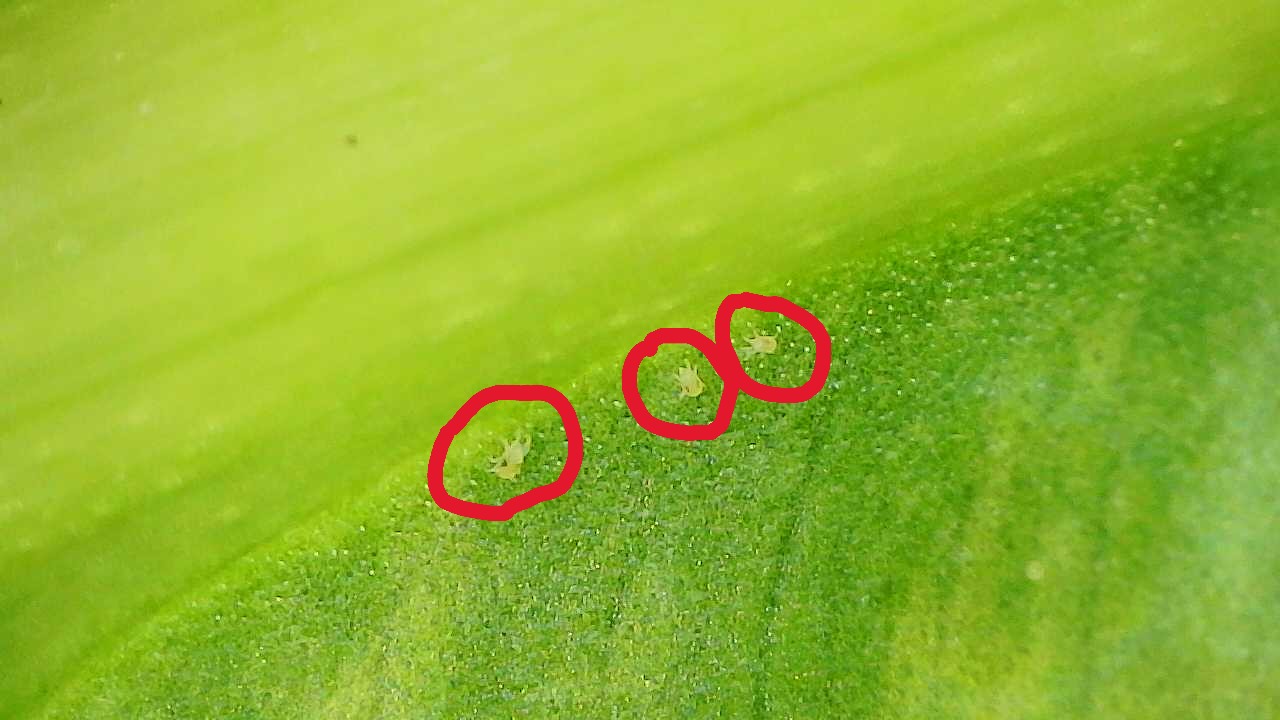
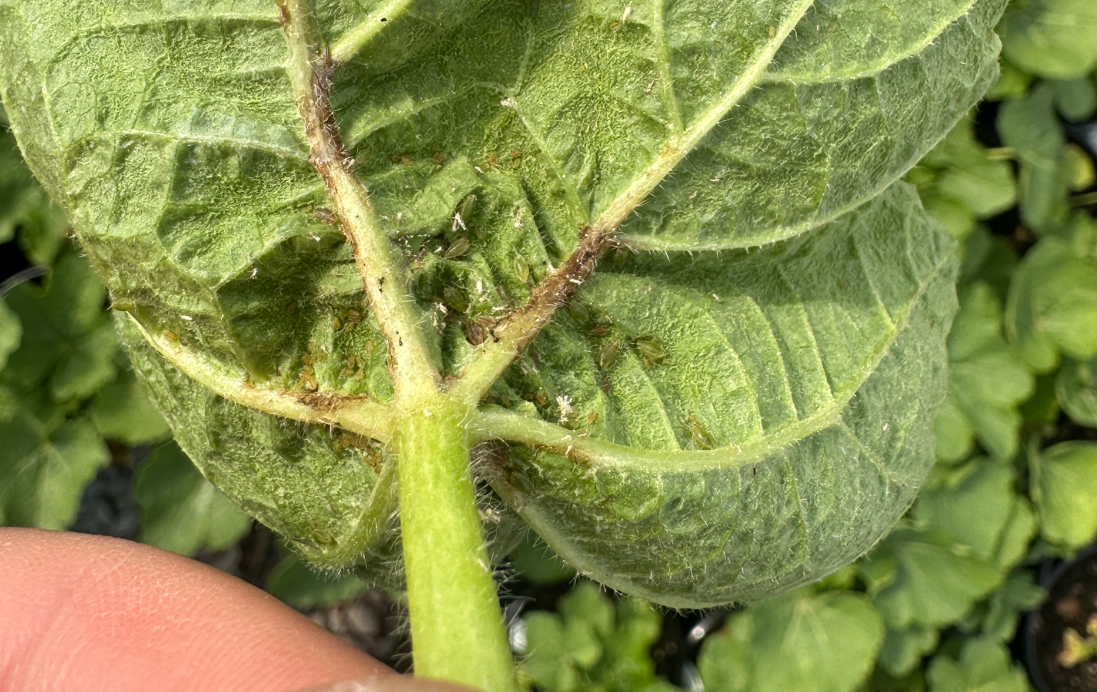
This assignment is perfect timing because on Monday I was scouting one of our houses and found a huge outbreak of aphids on a crop of hollyhocks. I immediately put out a sticky card to see if I can catch some and ID them. I checked the next day and saw no aphids on the card but they were all over the crop under the leaves (see photo). I did catch a few fungus gnats thought. I'm hoping to check back in a couple days to see if it caught any. I'm interested to see what else shows up in this other location. It seems like last week when we had that high of 72 degrees it may have created some favorable conditions for these aphids to get very active. An interesting point that I mentioned to the head grower is that the other crop in that house is asclepias tuberosa, one of our crops that is notorious for dealing with bad aphid pressure. I wondered if they may have over wintered in the containers of the asclepias and then infected the hollyhocks when conditions were favorable. I haven't Identified this aphid yet but I don't think it's milkweed aphid. For this find I entered it into my scouting record and messaged the head grower to inform him. He wanted to know if I had seen any anywhere else because he found some on another house on a crop of hypericum. I did end up finding some on a crop of aster divaricatus. 
In reply to Joseph Moreno

Re: Week 6 Assignment

by Elise Schillo-Lobdell -

Hi Joseph, I think I’m seeing a dark green stripe down the length of these aphids which means they are likely to be potato aphids.  This one is very active and like foxglove aphids it readily drops off the plant when it’s disturbed.  Aphidius ervi will go after these.

In reply to Joseph Moreno

Re: Week 6 Assignment

by Elise Schillo-Lobdell -
The bright school bus yellow/orange aphid often seen on milkweeds is Oleander aphid - many people call it milkweed aphid because that’s where they see it but I believe there is actually a different, small dark aphid, that is called milkweed aphid. Anyways, this is not Oleander aphid, but if you think your milkweeds may have overwintered some Oleander aphids then (also) keep an eye on your Hoyas and Mandavillias, as well as Oleanders, because they will go to those - as I’ve learned from overwintering some milkweeds :~{
In reply to Joseph Moreno

Re: Week 6 Assignment

by John Sanderson -
Joseph, I can't see clearly enough to be sure, but I think these are either green peach aphid or potato aphid (as Elise has suggested). But there are no winged aphids in this photo, so I wouldn't expect to see any aphids on a sticky trap. As for aphids and temperature, aphids are unusual in that their populations can develop just fine under cool (55-60F) temperatures, though a day or two of 72F would be excellent for them. Milkweed aphid and Oleander aphid are different common names for the same species, Aphis nerii. They are both schoolbus yellow with black cornicles. The other aphid that is common on greenhouse crops and has black cornicles is Aphis gossypii, the melon or cotton aphid. The bodies of melon aphids can be lime green to almost black but always with black cornicles. Notice that both of these species have black cornicles and are both in the same genus, Aphis.
In reply to Joseph Moreno

Re: Week 6 Assignment

by Amy Howansky -
Joseph,

I really love watching aphids on Asclepias in my garden. They are so colorful, and it is amazing how they are always stacked on top of each other in thick groups. I will now look much more closely for all of the identifying factors we have learned in class. Plus, I would like to take some pictures of them with my hand-held microscope, which is my new favorite toy… I have forced all of my friends to look at it, and they also find it exciting to use. My niece and I are now putting together a bingo game to be played by the cousins whereby they have to go out and scout for things using the microscope. Then they mark off the block on the bingo card if they find the item.

Amy
In reply to First post

Re: Week 6 Assignment

by Tiffany Donaldson -

1.Last week, I added a few more sticky cards to my propagation house. I did not notice any new insects, however, there were significantly more fungus gnats on the pots that house geraniums compared to the coleus plants. This week I added 2 more sticky cards to a spider plant and an additional geranium to see if something similar will happen next week.  

2. I am unsure if it is due to the warmer weather we have been having or the longer day lengths, but I am slowly discovering that my plants are needing more water. More geraniums at Allegany State Park are showing the leaf purpling that I found last week. Next watering, I am planning on giving all the geraniums some fertilizer.

3. Since I am the head grower, I will list some information I would like an employee to give me if I gave them the task of scouting.

I would like to see the date, location, plant species, pest presence/density, and plant health on a weekly basis. If any corrective action was taken (for instance watering a plant that looks wilted) that should be documented as well. If new pests were found or if it seems like pest pressure is increasing, I would like to know immediately.

 At the end of the season, it would be helpful to see a graph of what pests were located during the different times of the season. Markers on the graph showing when different treatment methods took place would also be helpful. This could show which methods of control were effective or not. This helps to make informed decisions for the following growing season.  

Also, this week while scouting I almost missed these 4 fungus gnats that landed on the black corner of one of the sticky cards! 

Attachment fungusGnat.jpg
In reply to First post

Re: Week 6 Assignment

by Amy Howansky -
Part 3:  report to the grower

After scouting at the greenhouse during this class, I would make the following recommendations to the grower/manager/owner:

I believe that many sections are getting over-watered. Root scouting showed many plants with under-developed root systems and soggy potting mix. There is also algae on the floor on some bricks in a walkway between two greenhouses. Since the walkway also includes a couple of stairs, the algae poses a significant safety hazard and possible litigation risk should someone slip and fall there. Many of the customers at this retail garden center are older and have limited or restricted mobility.

I would also suggest putting out educational materials about beneficial insects and “non-injurous” things. The manager mentioned that the business does not like to use beneficials because customers tend to see any insect or critter and think it is a “bag bug.” I understand this mentality, and have dealt with it myself when working with customers in greenhouse, nursery, and landscape environments.

However, there will probably, at some point, come a time when an infestation could be managed successfully with bio-controls, and if the employees started educating the customers NOW, it would make the use of beneficials seem less egregious. I don’t think the owners give their customers enough credit because the customers are from an educated, affluent, open-minded area of town, and are likely to accept information presented from reputable sources like factsheets from Cornell Cooperative Extension. The information could be presented in a fun way with little comics about different critters that are seen in greenhouses and nurseries.

One interesting thing that I noticed about pest control is that the owners have redesigned the interior of the main store area, and they moved all of the fertilizers and pest control products to a far back corridor. This makes the items much less “in-your-face;” maybe out-of-sight will equal out-of-mind and reduce the number of people who quickly resort to buying pesticide sprays for their houseplants. (This could, of course, also result in fewer sales, and therefore less earnings for that part of the business,)

I would also recommend that they put together a system for routine scouting. Right now it is done by “whichever person walks through the greenhouse kind of looks at the plants, and if you see anything you tell the greenhouse supervisor.” I think this method is causing them to miss some pests like fungus gnats. Granted, they have said that they never really get huge infestations, and they very rarely spray for anything, but I think a systematic approach to routine scouting would even further reduce issues. I did lightly mention that they could create a chart in the employee work area that lists who is scouting each day, and they could create a simple scouting form to be filled in or checked off as a task each day.

I also think that they need to have formal employee training. Most green-industry companies I have interacted with do NOT have formal training. Instead, they rely on the “throw you in the deep end and see if you can swim” method. I have never agreed with that method. Formal training, even if simple or short, is a better way to have consistency of knowledge throughout the department, and it ensures that all workers are following the same procedures. It also standardizes task performance methods such as how and when to water… which may be the issue here. Employees may be watering “whenever” and “however,” rather than with a consistent method or daily tracking system.

I will add assignment PART 1 and PART 2 in a separate post.
Amy
In reply to Amy Howansky

Re: Week 6 Assignment

by Cheryl Sullivan -
That is a disappointing view about customers thinking all bugs are 'bad'. One of our growers here is the largest in the state and it took years to get to the point where signs were put up about the bios for the public. Now they have signs on all their banker baskets and around that explain what the mite sachets are etc. The staff were probably sick of explaining what things were to the public all the time! It will come in time. Especially if sold from the standpoint of protecting pollinators. We have several businesses with signage now.
In reply to First post

Re: Week 6 Assignment

by Amy Howansky -
Part 1  Sticky cards

I placed a sticky card in a different greenhouse (HOUSE #1) on an Epripremnum (pothos), and saw the following:

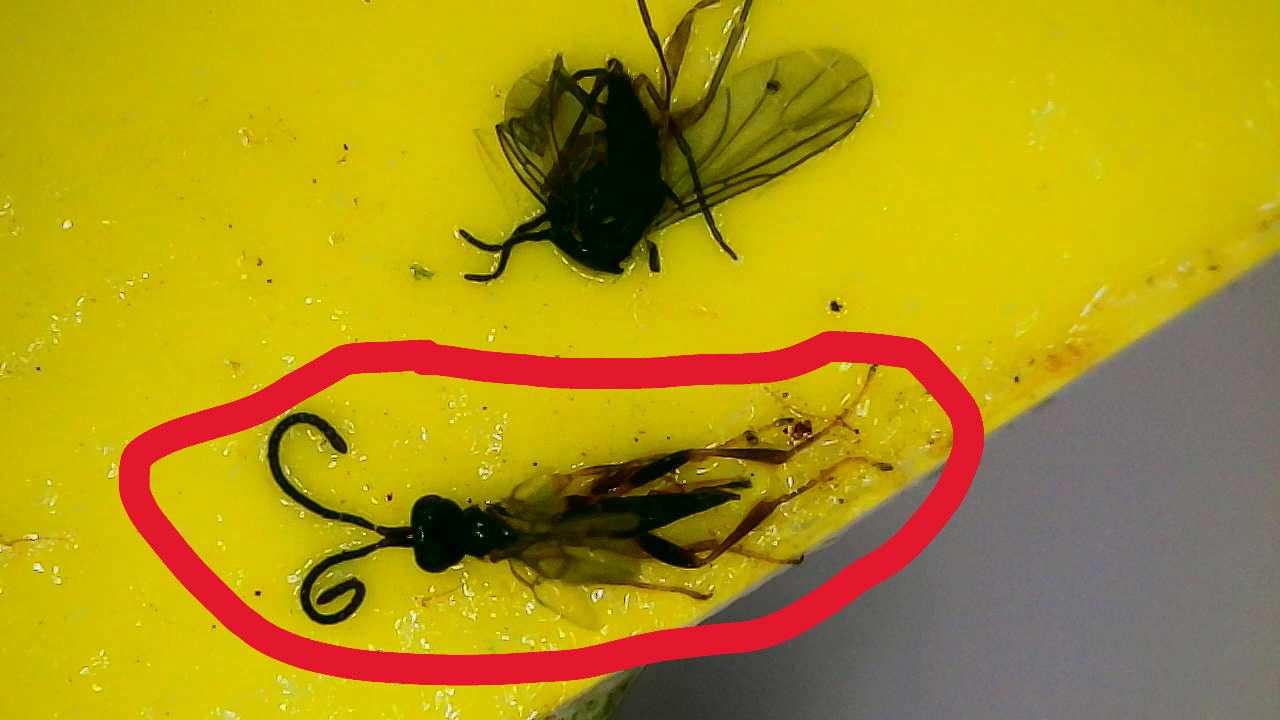
Yellow side 11 fungus gnat  and 1 unknown insect with curly antennae

Blue side 1 fungus gnat


Also in HOUSE #1, I placed a sticky card in a Dicksonia (Australian Tree Fern) and saw:

Yellow side 33 fungus gnats

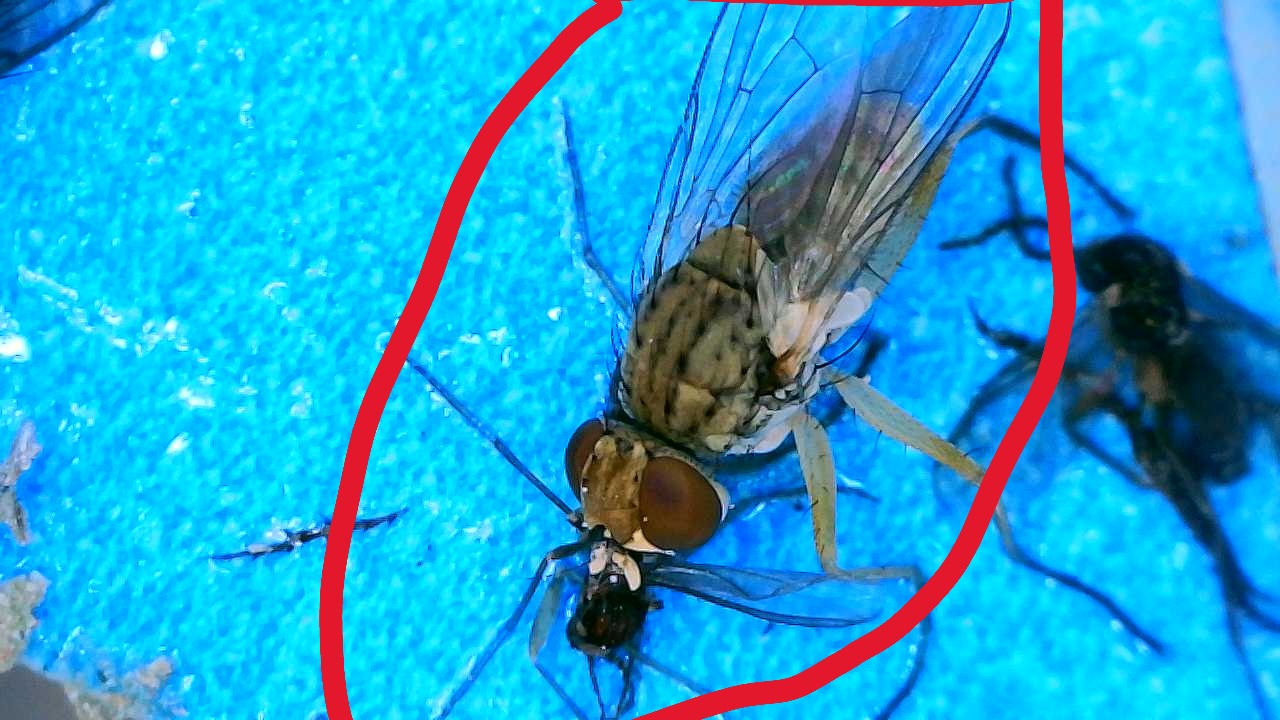
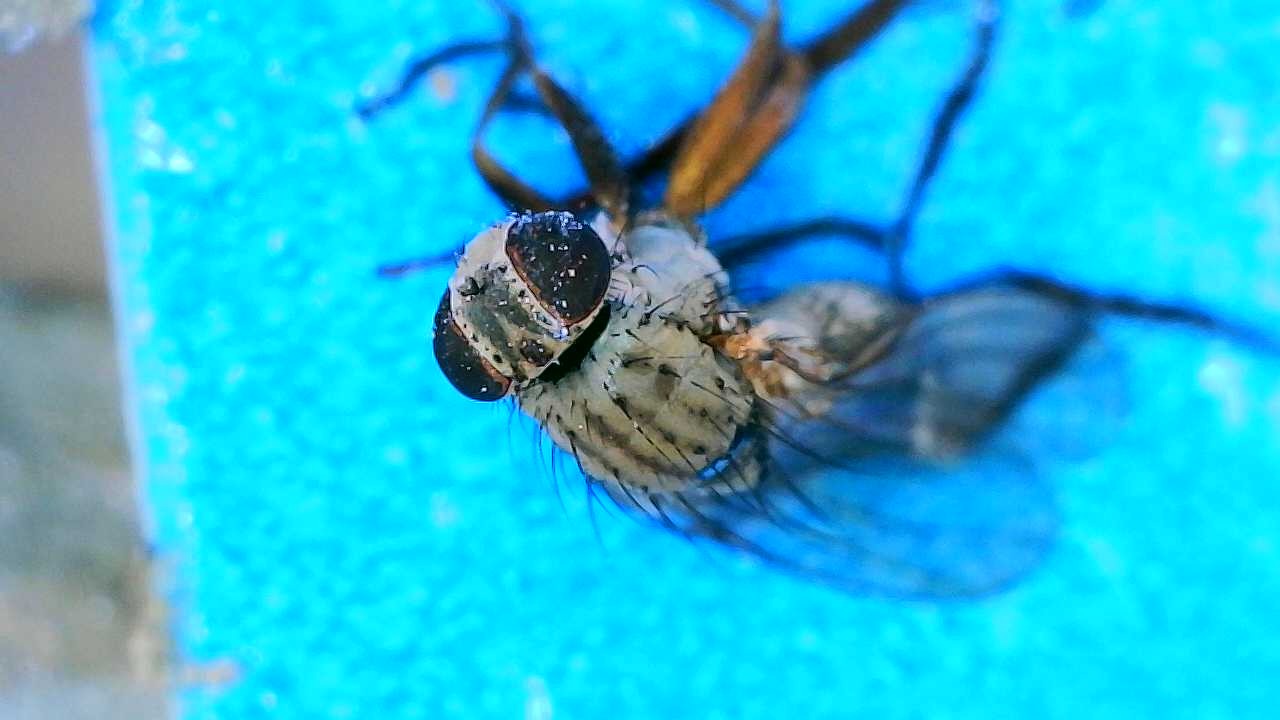
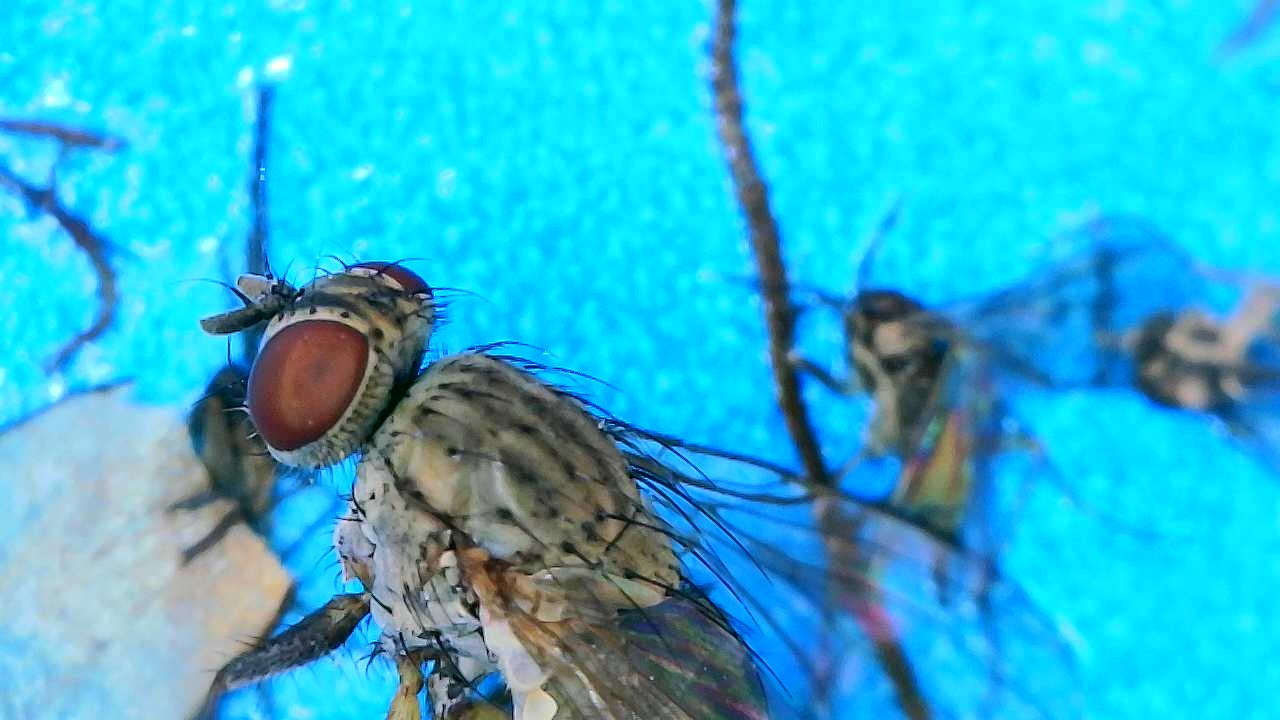
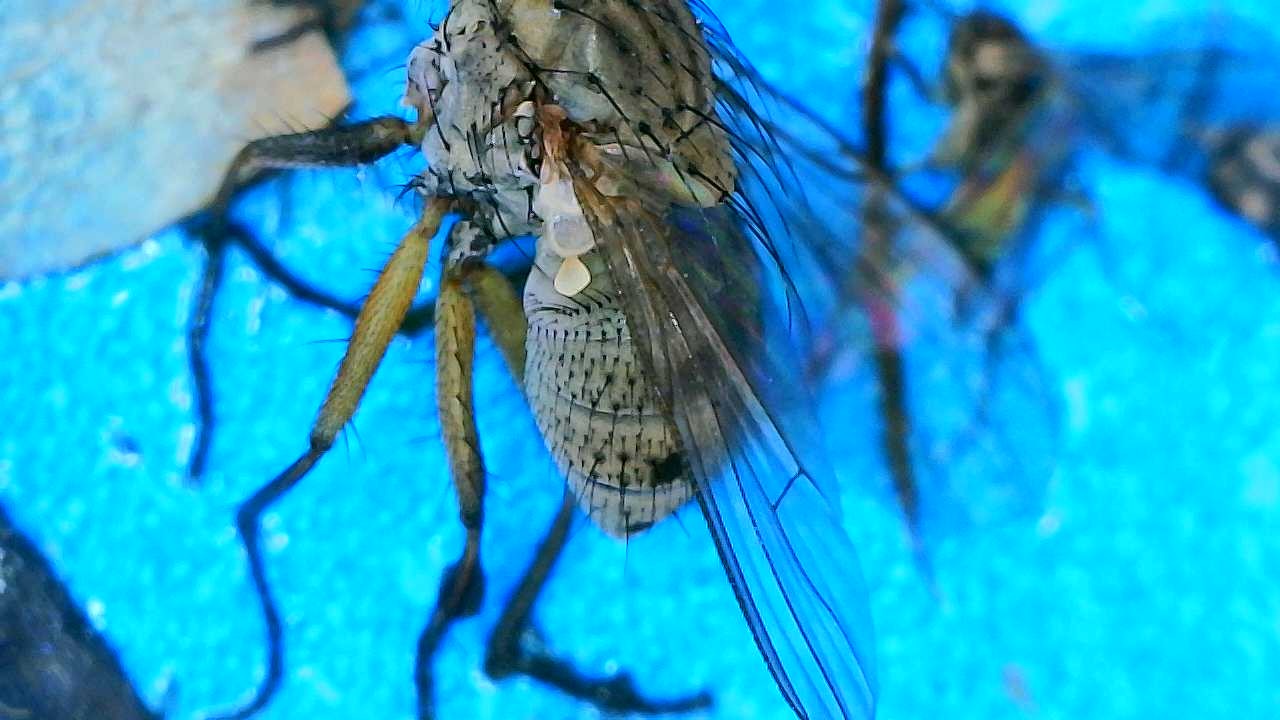
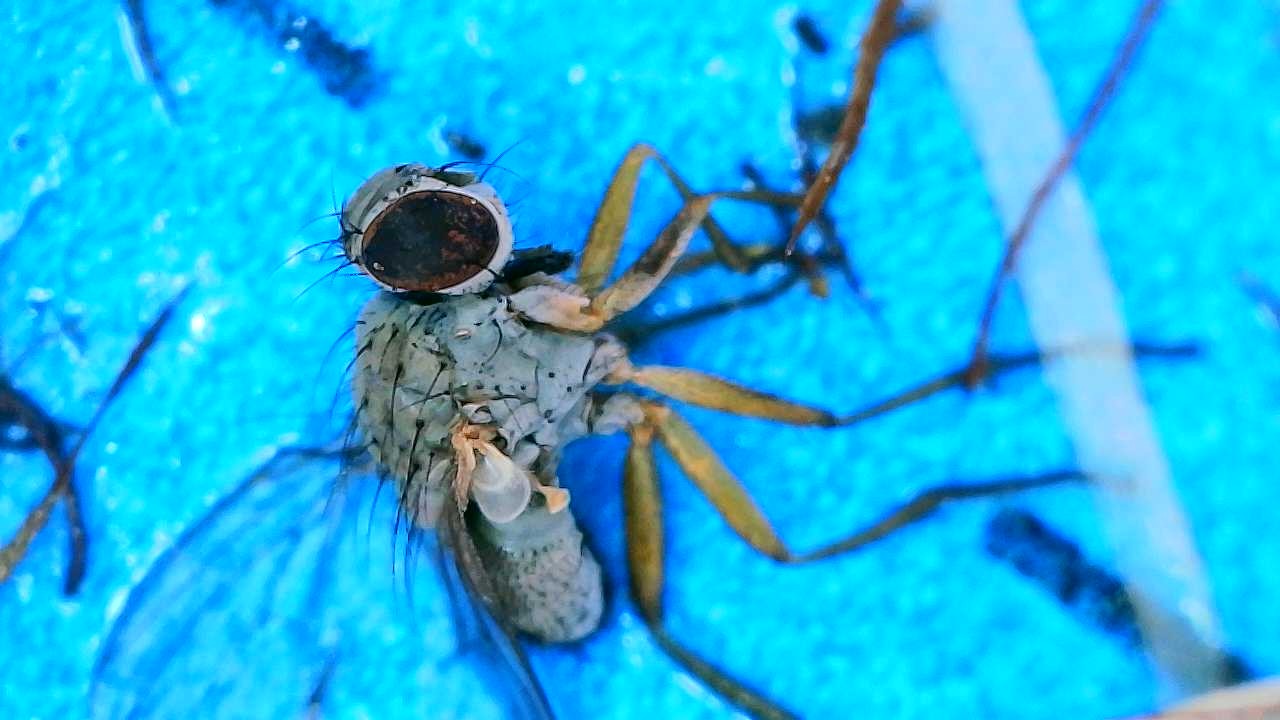
Blue side 138 fungus gnats and 7 unknown flies with large head and “striped back”

The flies are maybe Anthomyia procellaris?

In both cases, I used an Optivisor to preliminarily see and count the pests captured on the cards.  I then switched to the hand-held microscope to confirm and to examine the unknown pests more closely.

I realized when I got home that I had previously cleaned the house and found a cool, very large, hand-held magnifying glass that I wanted to try out for the sticky card examination, and that I had put it in my tool-kit bag, but I had forgotten to take it out and put it on the table. Duh! So, I didn’t use it this time.


Attachment Fly on Blue Sticky Card 1.JPG
Attachment Fly on Blue Sticky Card 2.JPG
Attachment Fly on Blue Sticky Card 3.JPG
Attachment Fly on Blue Sticky Card 4.JPG
Attachment Fly on Blue Sticky Card 5.JPG
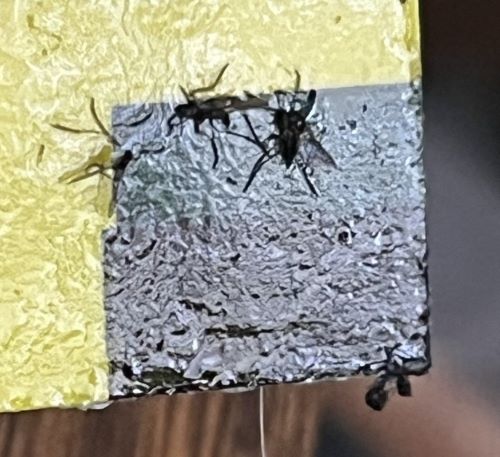
Attachment Parasitic Wasp on Sticky Card.JPG
In reply to Amy Howansky

Re: Week 6 Assignment

by John Sanderson -
Great close-up photos of hunter flies! In Photo 1 it looks like that hunter fly had captured a prey (fungus gnat?) and chose the wrong spot to land to eat it. Photos 4 and 5 show a female and male hunter fly, respectively. Note the fatter abdomen in photo 5 compared with that of photo 6. The last photo is of some sort of parasitoid, though I'm not sure of the species.
In reply to John Sanderson

Re: Week 6 Assignment

by John Sanderson -
Also, in case you wish to look them up online, the scientific name of hunter flies is Coenosia attenuata. (Diptera: Muscidae)
In reply to Amy Howansky

Re: Week 6 Assignment

by Elizabeth Lamb -
And you can see the halteres on the flies - one way to know it is a fly - 1 pair of wings and those whitish sort of wing shaped but smaller things below. Dredging up my entomology class!
In reply to First post

Re: Week 6 Assignment

by Amy Howansky -

Part 2 diseases (and other problems) on new plants that came in


The greenhouse received a huge shipment of tropicals since my last scouting visit.  The grower said they are often short on staff and time, and have to rush the new stock out onto the floor without being able to completely inspect anything first.


Since my last visit, they have made a couple of spot sprays on specific, target plants for mites.  Unfortunately, they did not realize that the grower had also sent some bio-control predatory mites with the foliage plant shipment, so the spray that was used killed the beneficials and the pests.  (We just read about this warning in the course work, and then I got to hear their story of how it actually happened in real life.)


The greenhouse has been getting warmer with the sunny days:  low 68℉ - high 86℉

There is no gauge for humidity in the houses.

Ceiling/peak vents are manually operated, but have not yet been opened this winter.  

A couple of fans placed above-the-head create air flow.


I was able to examine several plants and found:


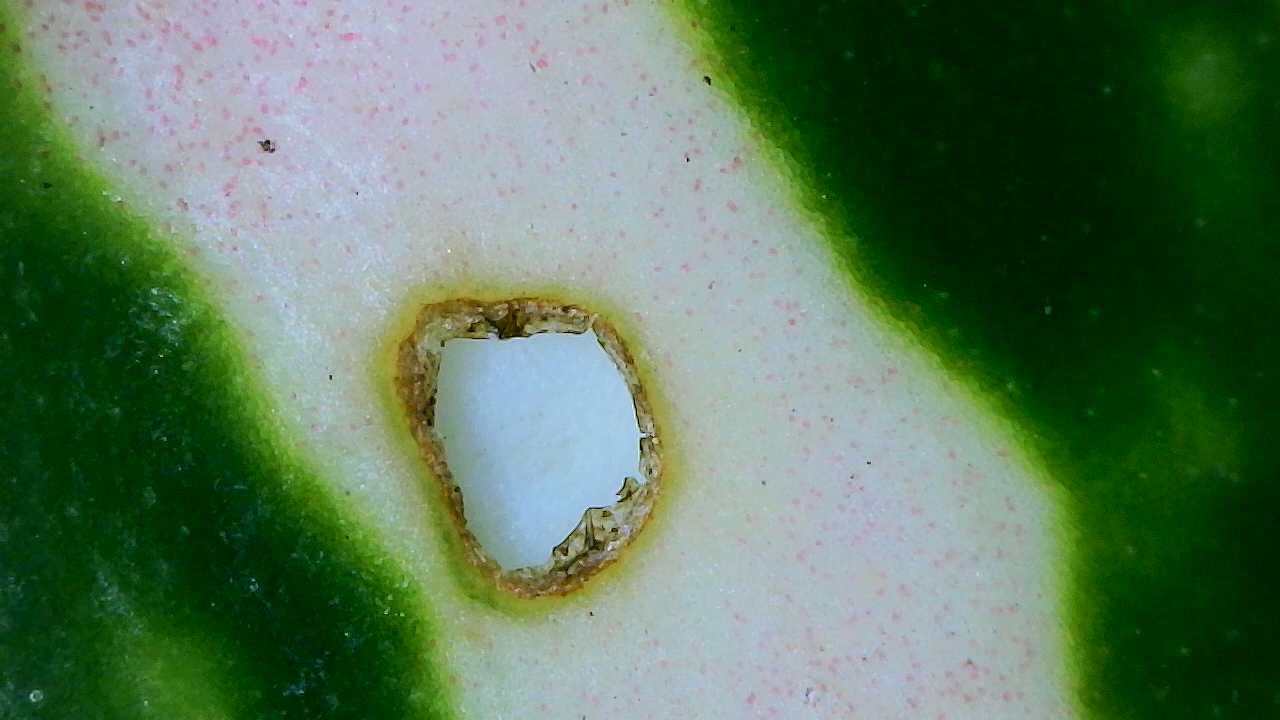
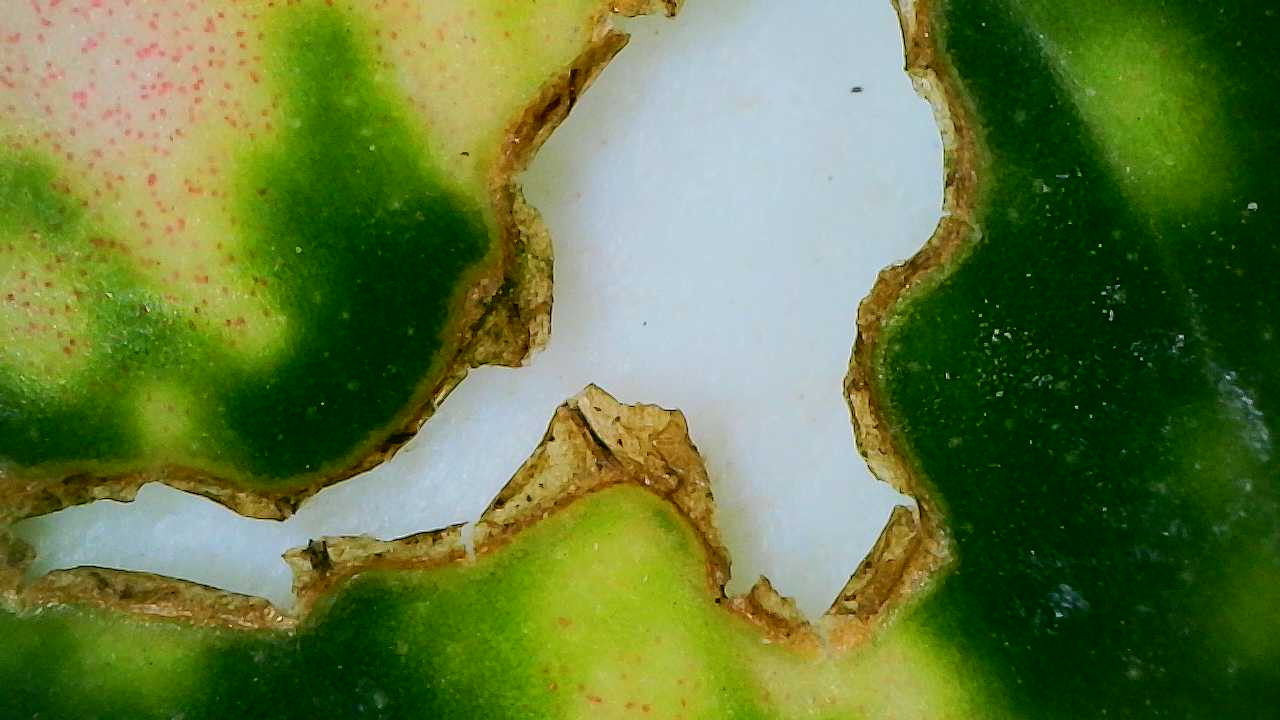
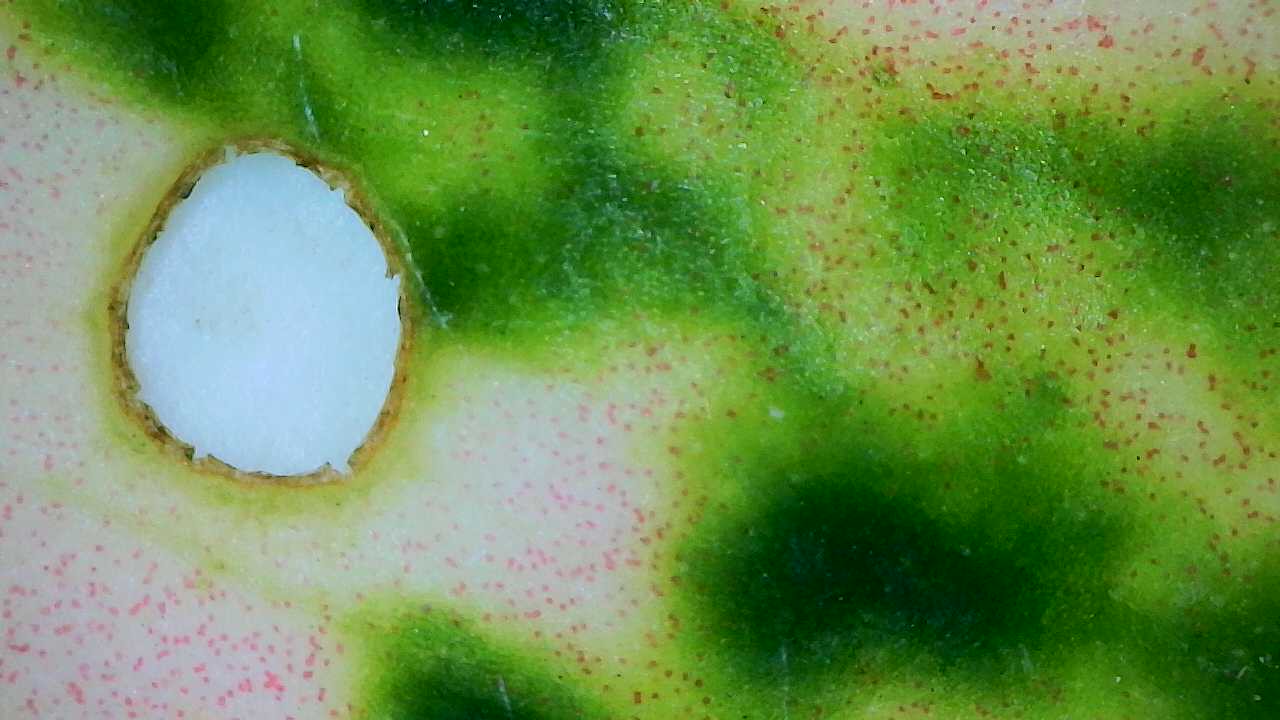
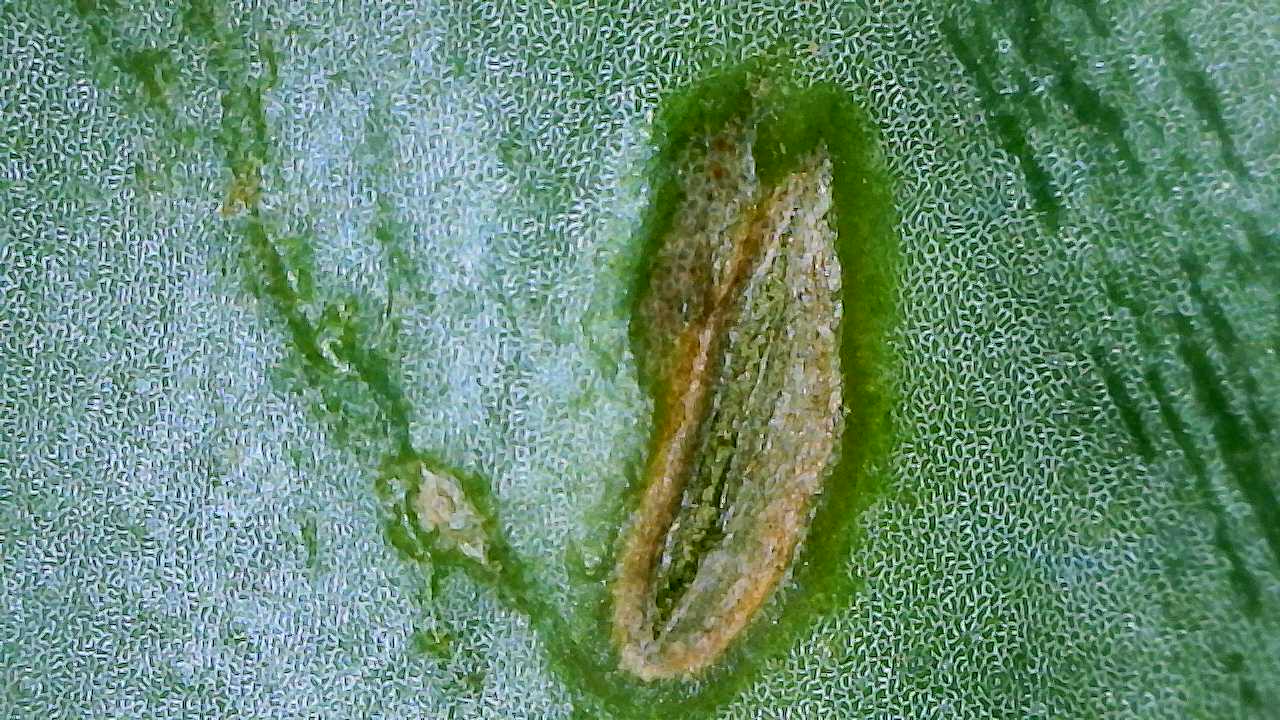
Aglaonema ‘Etta Rose’ (with green and pink variegation)... I found several small, perfectly round holes in the leaf tissue.


Aglaonema ‘Silverado’ (with green and white variegation)... 

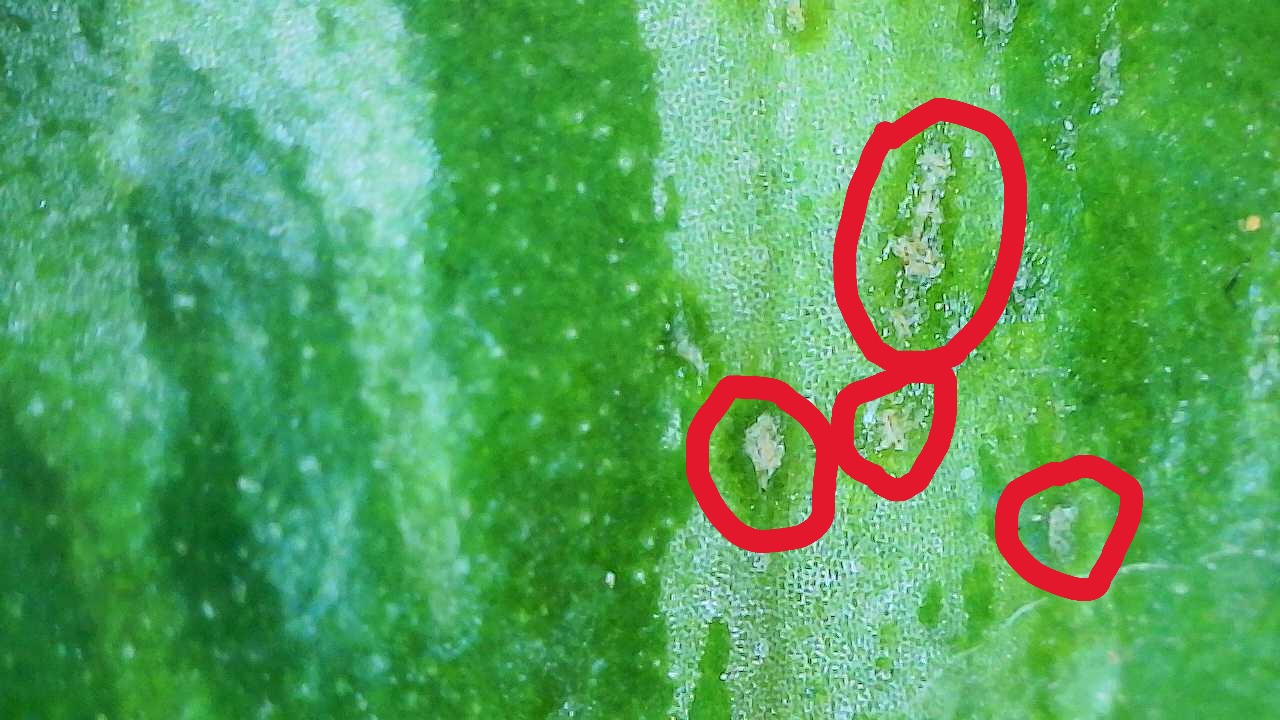
There is some color-break or fading of color on the leaves, though maybe not apparent to people not familiar with the species.  


There is also thin yellow streaking.


And, there are some leaf spots that look brown and dried up.


And, there was one spot (half the size of a nickel) that looked black and water-soaked.  It had a yellow margin ring around the black area.  I tried mimicking a method we read about in the course materials to see if the spot was bacterial:  I cut through the damaged spot and placed the leaf tissue in a flat tray with some fresh, clear water to see if any grey clouds of bacterial spores oozed out, but I did not see any.


The thin, yellow streak might suggest color-break and therefore a virus or viroid.  


There were also bumps and curled distortion at the leaf tip on one Aglaonema leaf, which might suggest edema or viral distortion.


I examined it with the hand-held microscope.


More from Part 2 of this assignment in a separate post.


Attachment Aglaonema Etta Rose 2.jpg
Attachment Aglaonema Etta Rose 3.jpg
Attachment Aglaonema Etta Rose Leaf Hole 1.jpg
Attachment Aglaonema Silverado 1.jpg
Attachment Aglaonema Silverado 2.jpg
Attachment Aglaonema Silverado 3.jpg
Attachment Aglaonema Silverado 4.JPG
Attachment Aglaonema Silverado 5.jpg
Attachment Aglaonema Silverado 6.jpg
In reply to First post

Re: Week 6 Assignment

by Amy Howansky -

Part 2, continued

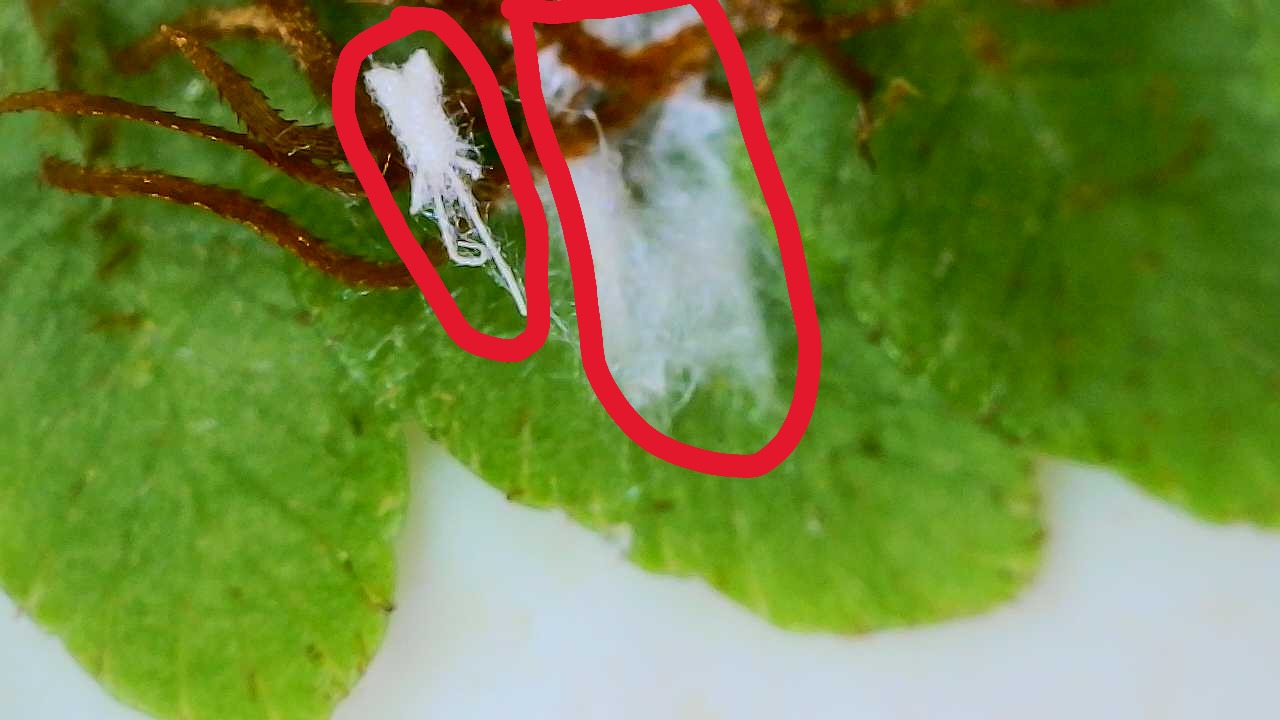
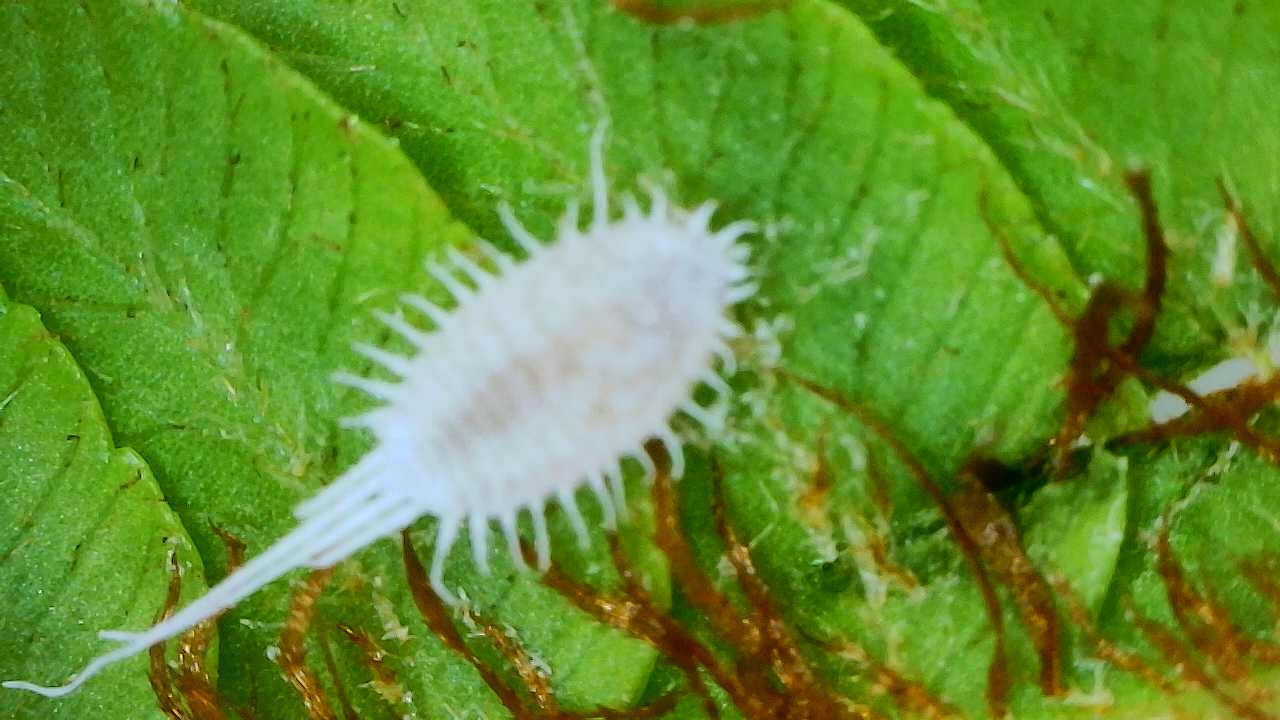
Dicksonia (Australian Tree Fern)... This is the same plant where I had placed a sticky card.  The manager thought he had seen a mealy bug on it a couple of days earlier, so we both examined it and found three possible mealybug indicators.  I examined them under the hand-held microscope and found two living, long-tailed mealy bugs, and one that was not moving.  They were all on separate leaves, but all on the mid-ribs of each.


One of the active ones ran off of the leaf tissue and onto the table.  They look really fast when you are trying to hold the tiny microscope lens over their body to get a still picture.  I also took two video of them moving, but I can't get them to upload because they are too big.


Attachment Long-tailed Mealy Bug and Wax on Dicksonia Australian Tree Fern.JPG
Attachment Long-tailed Mealy Bug on Dicksonia Australian Tree Fern.JPG
In reply to First post

Re: Week 6 Assignment

by Amy Howansky -
Part 2, continued

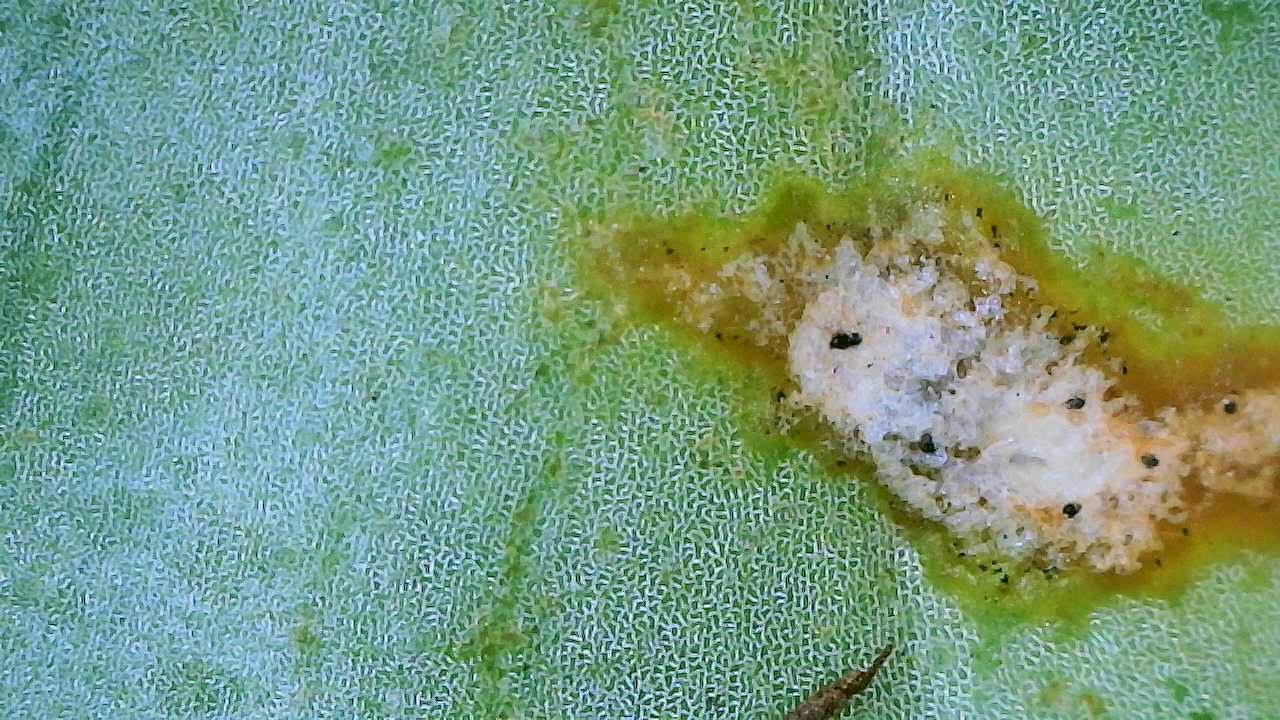
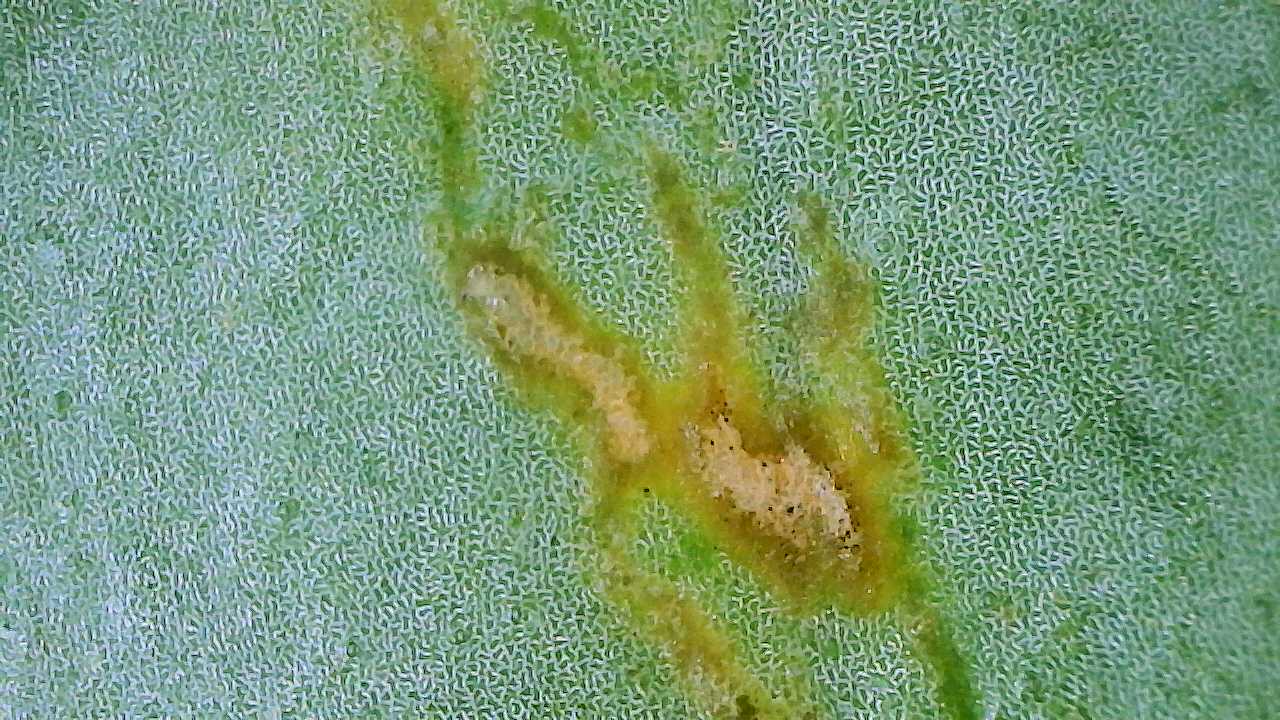
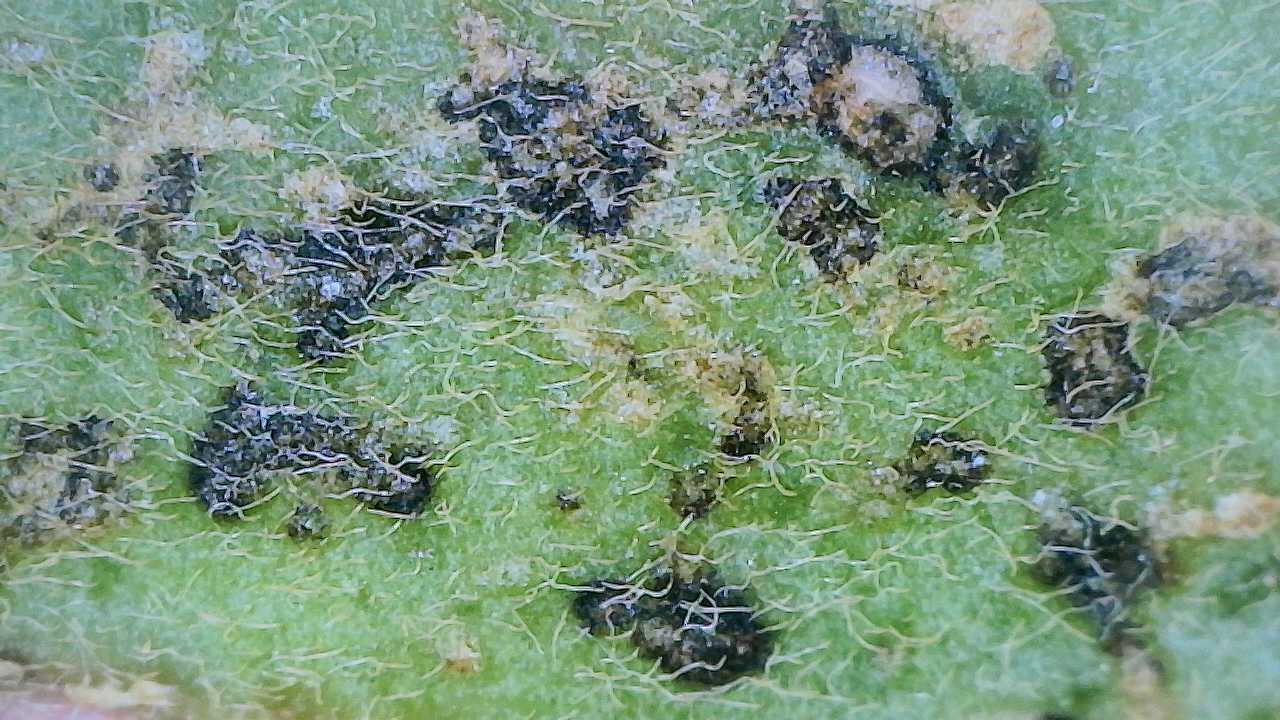
Hoya… I looked at some 3” pots that each had the youngest, terminal leaf curled, distorted, bumpy, and with some black markings.  The symptoms might suggest cold damage, which Hoya are very susceptible to, or perhaps broad mite or thrips damage, but when I examined it under the hand-held microscope, I did not see any pests.  I did see black areas/lesions that suggested a bacterial problem perhaps.


Philodendron ‘Green Congo’... It has large, dark green leaves, but there were several spots that were haloed with yellow.
No pictures of this one.  

Attachment Leaf Surface Damage on Hoya 1.jpg
Attachment Leaf Surface Damage on Hoya 2.jpg
In reply to Amy Howansky

Re: Week 6 Assignment

by Elise Schillo-Lobdell -

It also helps to have a few photos of the whole damaged leaf and maybe one of the whole plant.  Sometimes these damaged areas look way scarier super magnified like this but when viewed at a bit of a distance it just looks to be normal wear & tear - that can often be remedied by removing the offending leaf.

In reply to First post

Re: Week 6 Assignment

by Amy Howansky -

Part 2, continued

Algae on the brick stairs and connector space from Greenhouse #1 to #2.  No pictures.

Alocasia gigantea ‘Aurea’, newly arrived, 3-4” pots… It took the entire course, but I finally got something really cool… and creepy… and cool.  During my talk with the two managers, one mentioned that they had seen mites on the Alocasia a couple of days ago, so they had done a diluted alcohol bath on the foliage and returned the plants to the sales floor.  They had forgotten to tell me that during our initial talk about treatments done during the last week.  That made me realize that I have to ask questions the way I do when working with landscape clients:  ask multiple questions about the same basic thing, but from many different angles to make sure we cover everything.


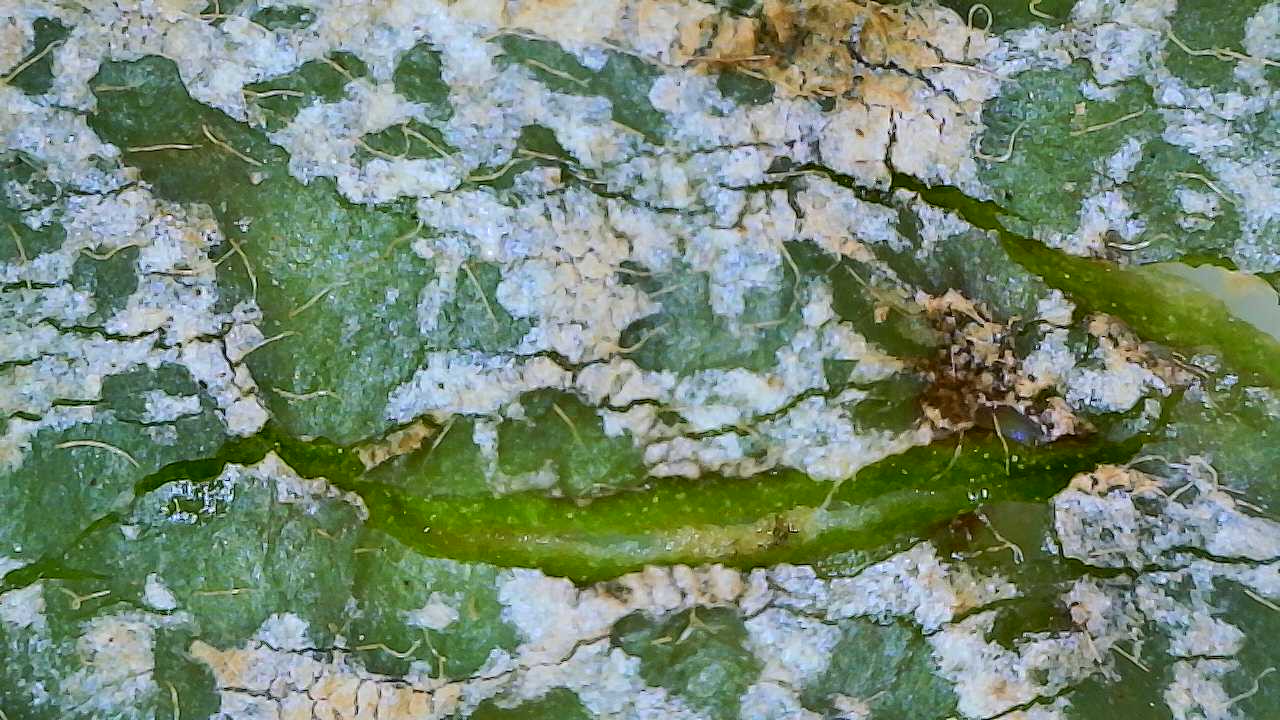
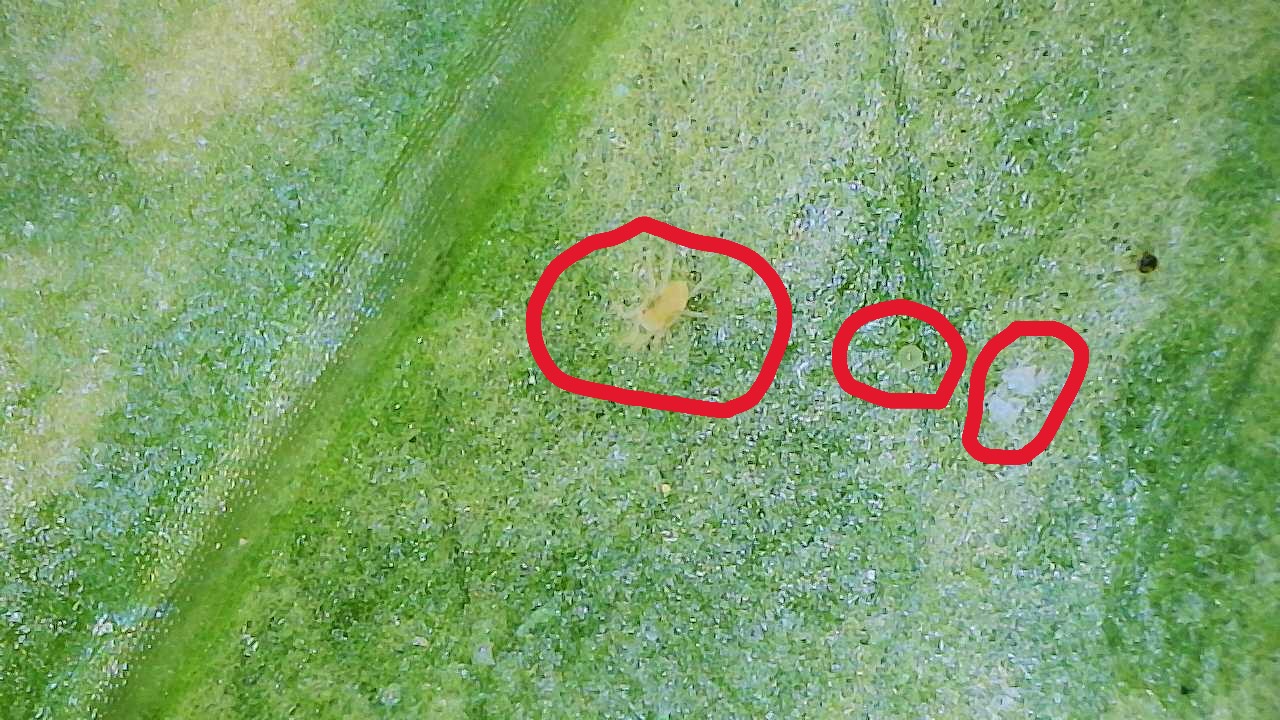
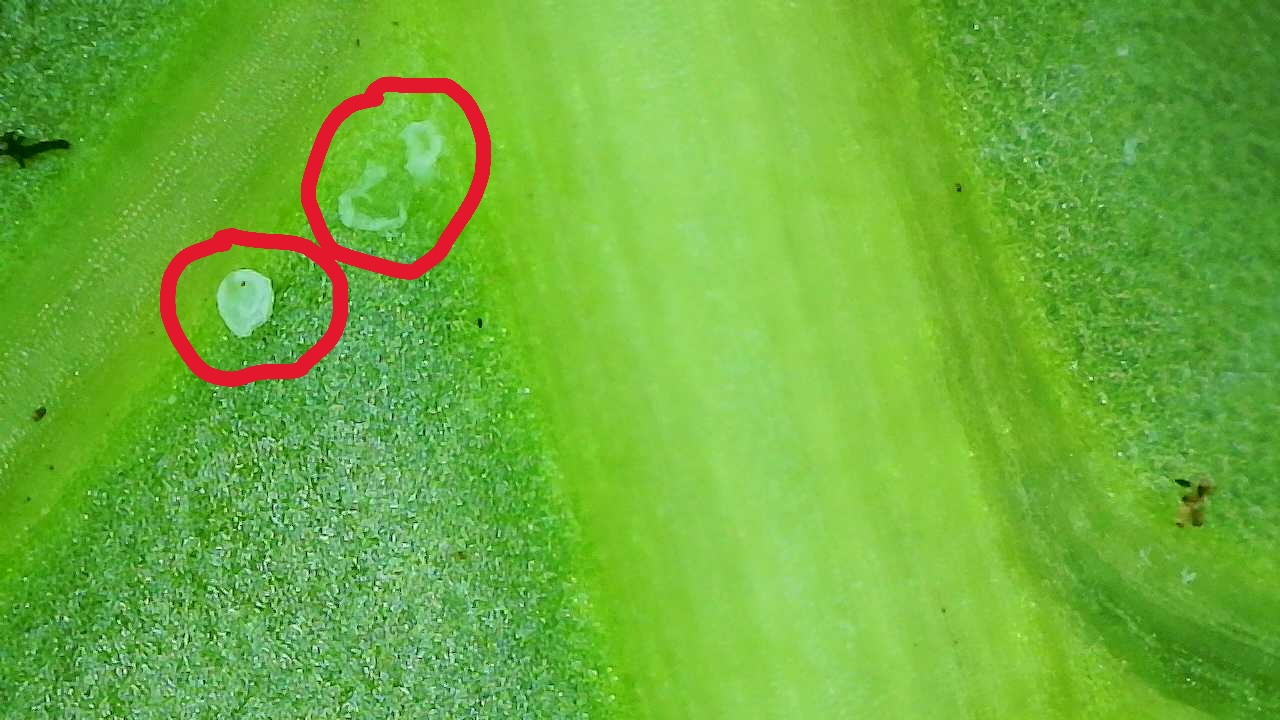
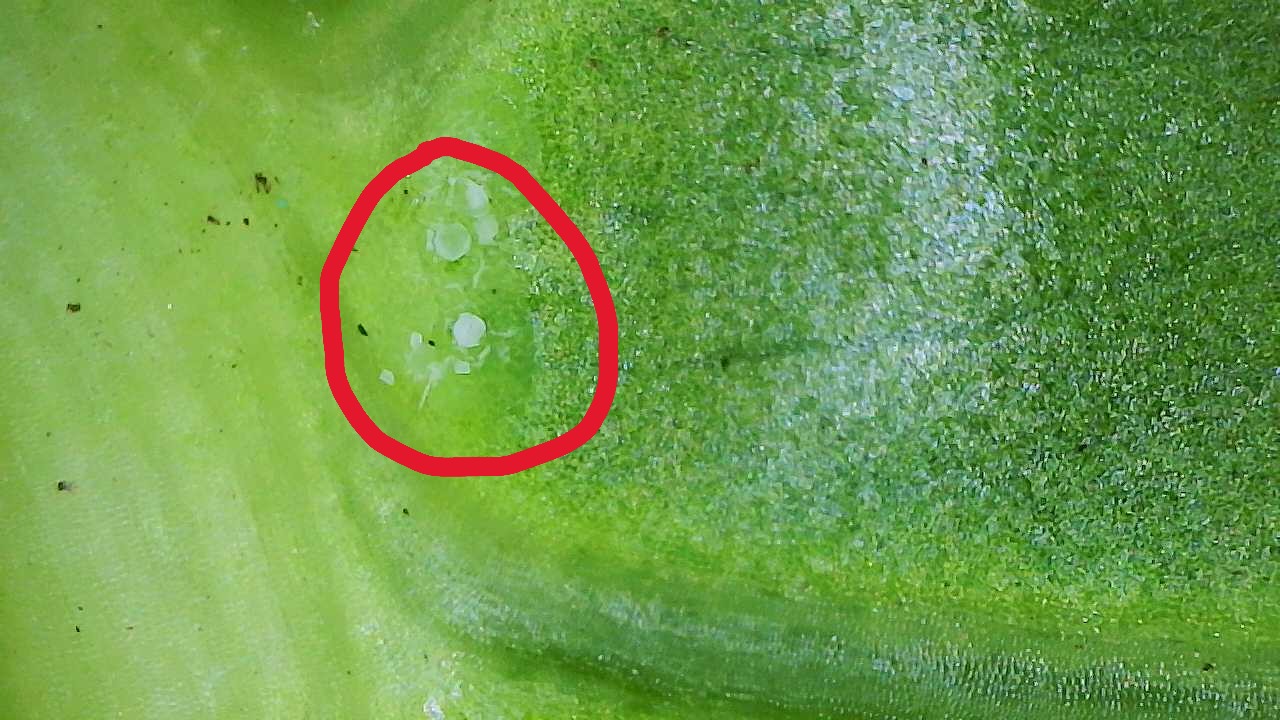
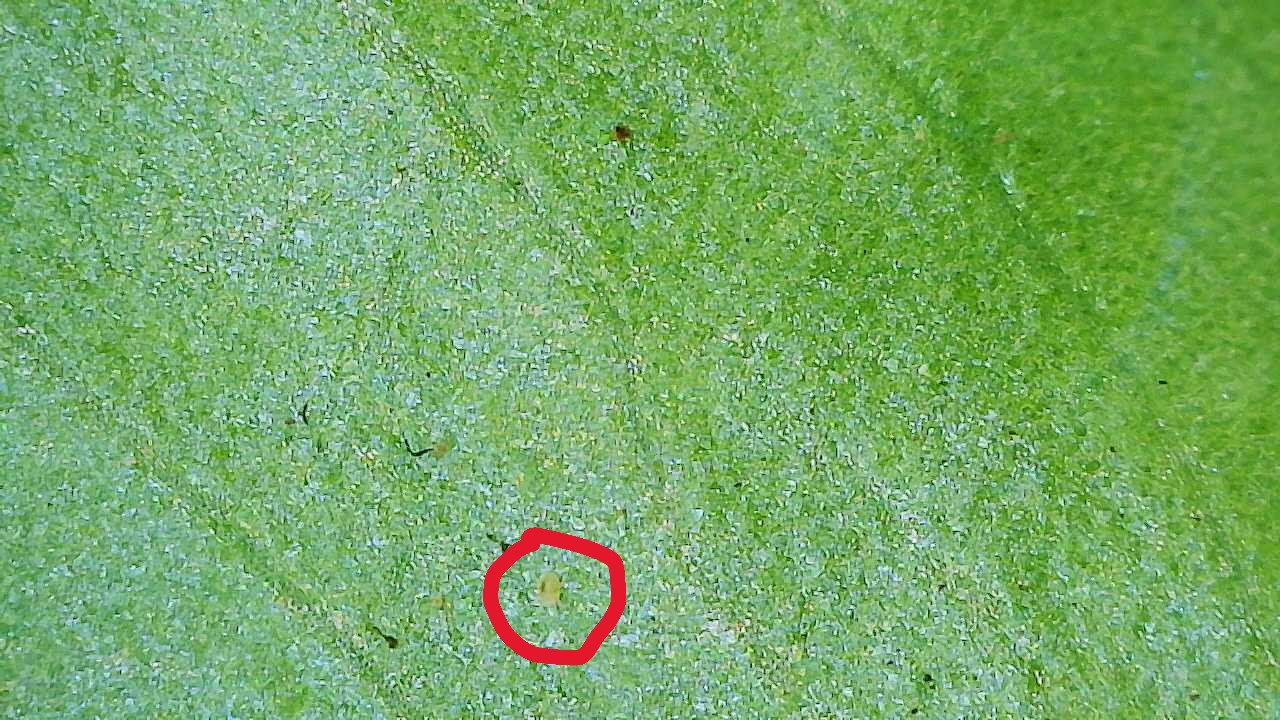
I examined the Alocasia  and found… wait for it… two-spotted mites running around and tending their eggs!!!  We were all very excited, and then one manager said that viewing the mite with her egg almost made him feel sorry for her.  The mites themselves were not on mid-ribs or side-veins, but I think I found some cast skins on the mid-rib.  You can hear me gasp on the video when I actually look at my computer screen to see what the microscope is capturing.


I then ran the hand-held microscope all the way along the mid-rib and found, what I think are, mite cast-skins or maybe egg casings opened, or maybe just damage from mite activity. ??  They were in a long row and clinging to the vein.

I am bummed that I could not get the videos to load because of their size.  I had mites crawling and mealy bugs running.  I appreciate any advice to get the videos to load.  Thank you, everyone.


Attachment Two-spotted Mite Adult, Molt, and Egg on Alocasia gigantea Aurea 4.JPG
Attachment Two-spotted Mite Molts on Alocasia gigantea Aurea 1.JPG
Attachment Two-spotted Mite Molts on Alocasia gigantea Aurea 2.JPG
Attachment Two-spotted Mite on Alocasia gigantea Aureum 1.JPG
Attachment Two-spotted Mites on Mid-rid of Alocasia gigantea Aureum.JPG
In reply to Amy Howansky

Re: Week 6 Assignment

by Cheryl Sullivan -
Really like the mite images. The videos are great also although I don't have advice on how to get them to load other than they are probably just too large.
In reply to Amy Howansky

Re: Week 6 Assignment

by John Sanderson -
Good photos! The first photo clearly shows a motile mite, an egg, and a mite's cast skin. The 3rd photo looks like a couple eggs. I like the last photo because it shows what the first two motile stages of spider mites look like. Note that the two mites on the right only have 6 legs, while the one on the left has 8 legs. The 6-legged larvae are what hatches from an egg. After 2-3 days they molt into 8-legged protonymphs. After another 3-5 days, the protonymphs molt into 8-legged deutonymphs, and then finally into the 8-legged adult.
In reply to First post

Re: Week 6 Assignment

by Shawn Jenkins -
I placed cards in some different areas amongst new transplants. So far nothing to report from that greenhouse. These plants are very small and young and the weather hasnt shifted much with sun and warmth but I suspect in the next fewws to see more in the way of pests and signs of disease.
The greenhouse that has the ferns and coleas is much better in the way of pests but still fungus gnats and thrips and a few shore flies also. As the vegetaion outide these houses grows wit the now melt and warmup we will see an increase of visitors in the greenhouses due to side and top vents and unsuspecting students/greenhouse workers.
I have talked to the grower/ professor and he is aware of the issues of pest we have had/been managing since start of semester (late January):
Ongoing fungus gnat infestation due to improper watering
persistent mealy bug infestation on some plant varieties: should discard them as eradication efforts have been unsuccessful
Plants are being overwatered: unfortunate condition of learning greenhouse
Greenhouse needs to be more sanitary, floor under benches swept
we talked bout beneficials: He likes to bring in lacewing and parasitic wasps traditionally, we tried lady bugs last year usually brings them end of March/beginning of april as plants are developing and pet pressure increases with warmer weather
In reply to First post

Re: Week 6 Assignment

by River Waterman -
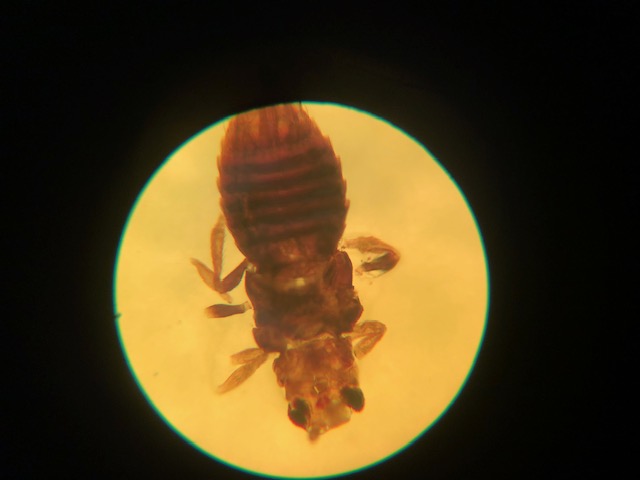
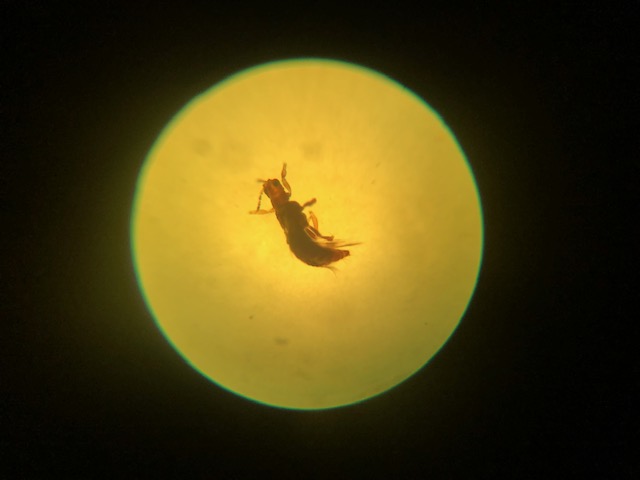
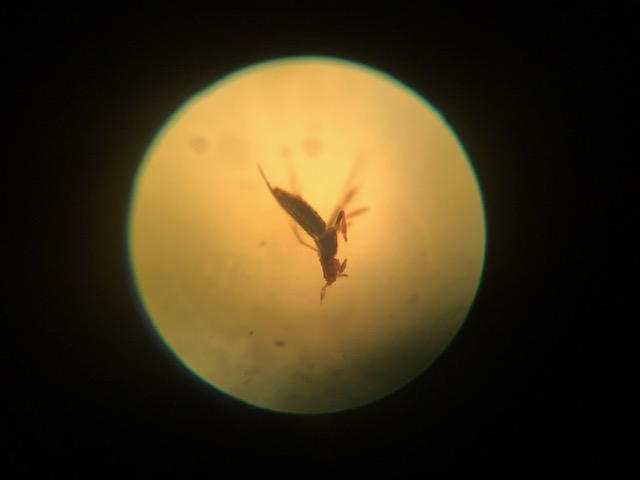
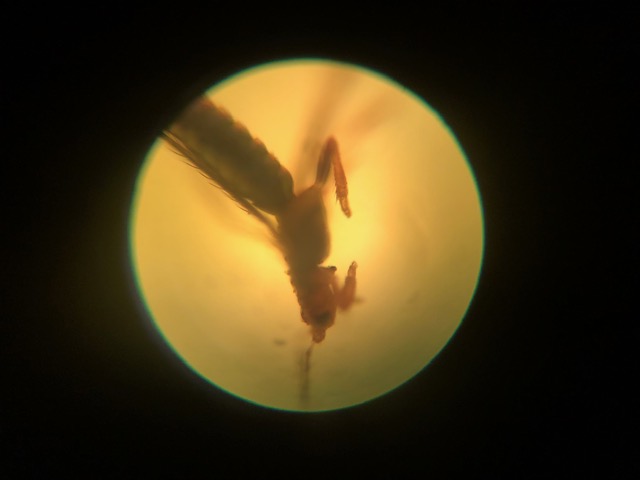
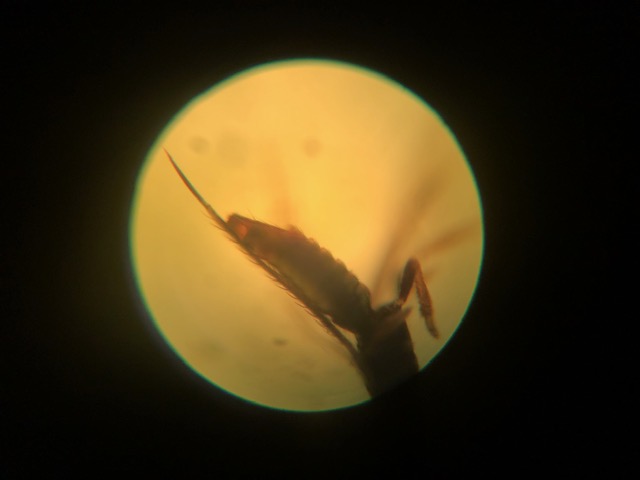
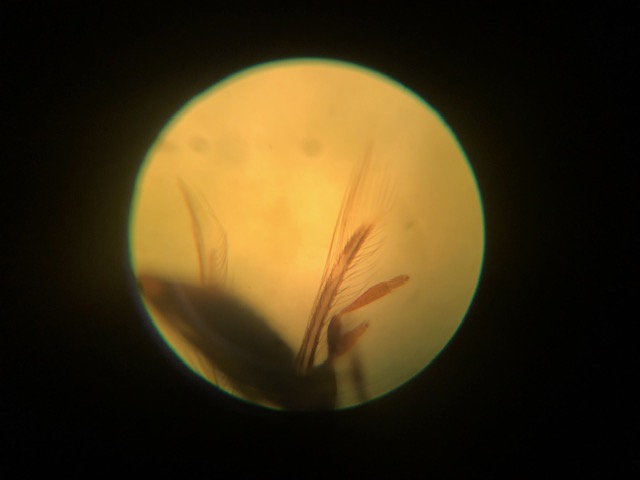
I caught some thrips!
There were three of them on one of my yellow sticky cards and though they did get a little smushed, I was able to take them into school to look at under a real microscope! The pictures still aren't the best because my phone camera is not great, but it was really cool to see them up close
thrip
thrip
thrip
thrip
thrip
thrip
In reply to River Waterman

Re: Week 6 Assignment

by Cheryl Sullivan -
What crop was the card in? Im not sure I can tell what thrips that is without seeing how any segments are on the antennae. BUT I do want to share this website that has amazing images of thrips!
https://www.thrips-id.com/en/
In reply to First post

Re: Week 6 Assignment

by Ryan O'Connor -
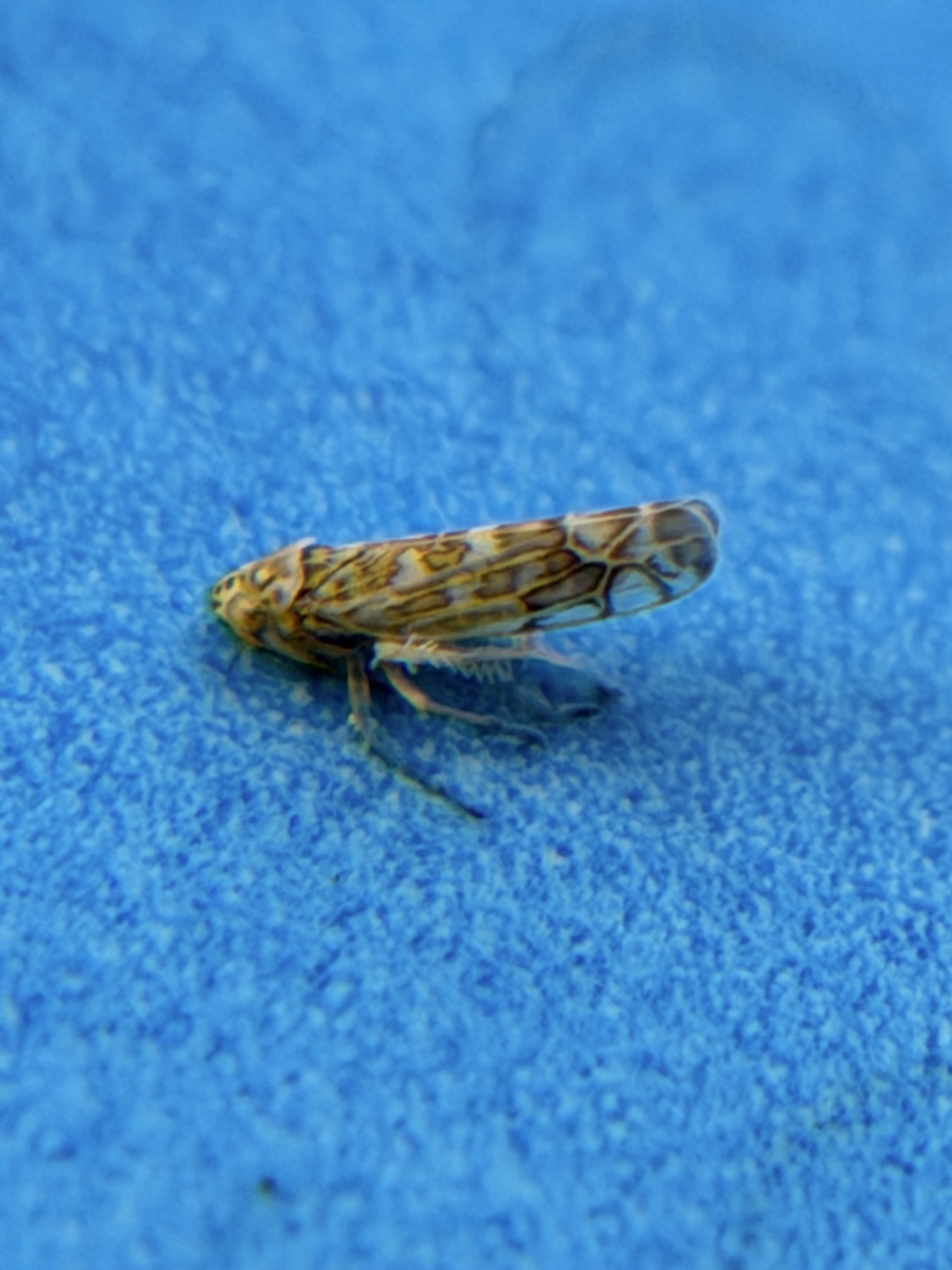
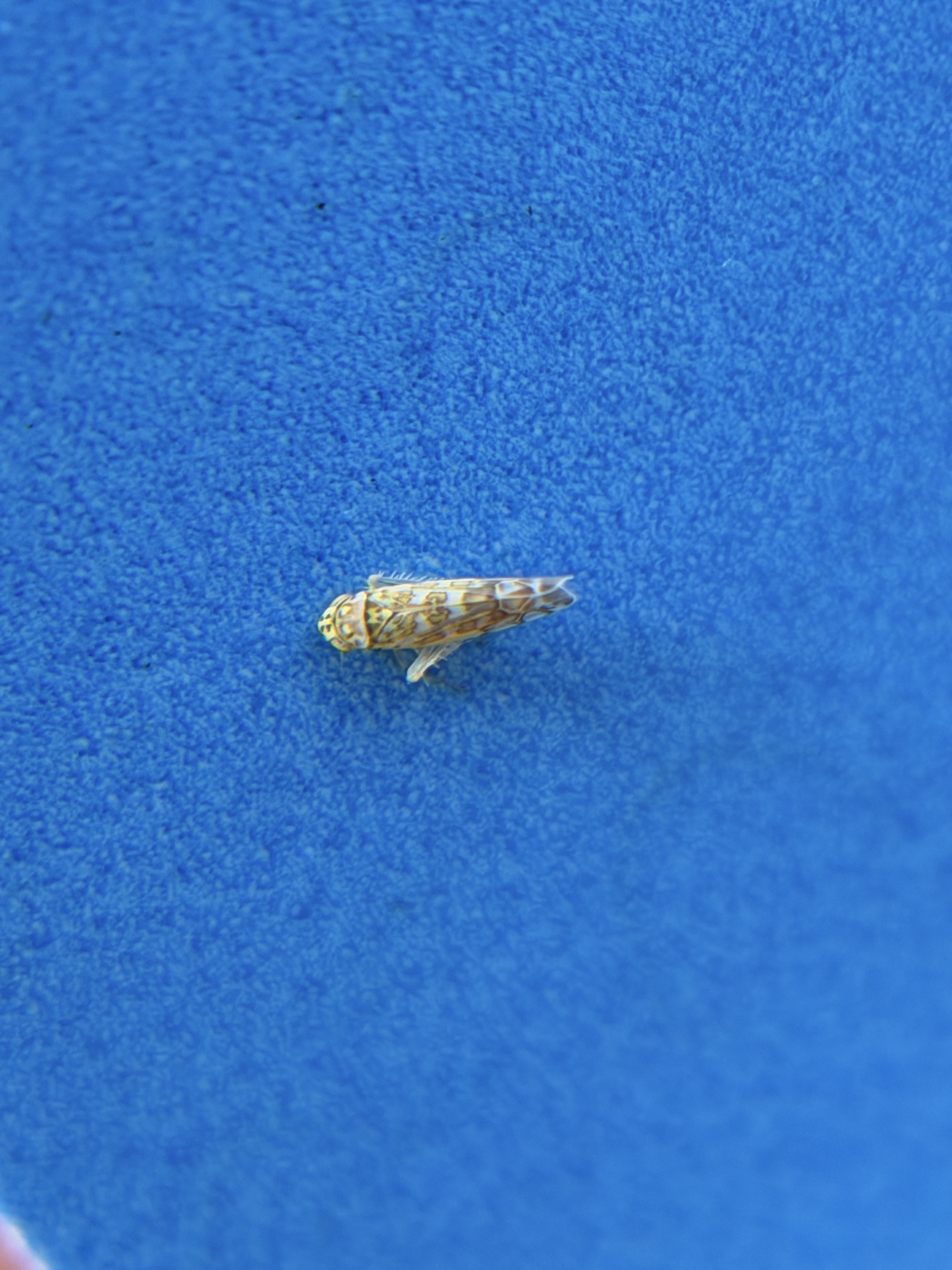
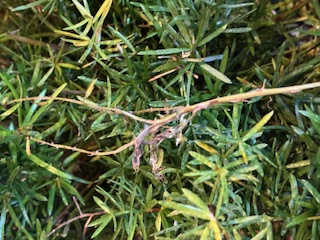
1. I noticed some stippling on our rosemary so I put a blue card above the canopy because we have had some thrips on our rosemary in the past. I didn't see any thrips on the card although I did see some larvae instars on the leaves crawling around. I'm assuming that is what is causing the stippling. I released some cucumeris couple days ago to hopefully eat those guys up. However, I did get an interesting catch on the card. I think its a leafhopper?
 

2. Haven't really seen too much change in the greenhouse except that we are getting more sunny days and our container plants and bulb crates are drying out more quickly than before. Which is good for the fungus gnats and shoreflies!
In reply to Ryan O'Connor

Re: Week 6 Assignment

by John Sanderson -
Ryan, yes, that is a leafhopper of some sort. I wish I knew them better so that I could suggest a species. They are among the pests of rosemary, and it might be possible that your leafhopper is rosemary leafhopper. But I can't say for certain. Here's an article on leafhoppers on rosemary; note the stippling damage that they cause. Does it look like what you're seeing?
https://www.umass.edu/agriculture-food-environment/greenhouse-floriculture/photos/leafhopper-damage-to-rosemary
In reply to First post

Re: Week 6 Assignment

by Sathwik Manjunath -
1) I got some different insects when i changed the location of the sticky cards , i got more general species of thrips and less western flower thrips compared to last time .and placing the card based on growers suggestion helped me find more thrips near certain plants
2)There was no addition of plants and did not see any disease in the greenhouse plants other than some existing wilting on some plants.
3)I talked to Julie grower in KPL greenhouses .She is experienced , already knew the presence of thrips near her coffee plant and was able to take action on that.I would give her the number of thrips population increasing in certain places of the greenhouse and there was a decrease in number of adult fungus gnats compared to last two weeks.
In reply to First post

Re: Week 6 Assignment

by Grace Harper -
After scooting the sticky cards around, a few different pests were trapped. I have been seeing shore fly's here and there on the sticky traps, but when I moved it to the end of the geranium table and to the begonias even more were trapped. It's crazy because I don't see them flying around but there was close to 30 on one of the traps. I saw a deceese in fungus gnats as well.
The most common thing I'm seeing on plants right now is deficiency. The most common one I'm seeing is nitrogen, and on the geraniums it's a good mix between nitrogen and phosphorous. Most of the stuff in the greenhouse is grown off except for the few plugs that are trickling in. The plugs seem to be suffering from overwatering and are being stunted.
I haven't really talked to the grower, but if I were giving a report this it what I would tell her.
The begonias and geraniums have seen an increase in fungus gnats and shore fly's. There is still a lot of FG larvea in the geraniums. The aphids in the west greenhouse are taken care of.
The geraniums are deficient in nitrogen and phosphorous, as well as having root rot and grey mold. They seem to be stunted and are at a level 4 on the moisture meter. Some of the plugs are also experiencing the same thing.
In reply to First post

Re: Week 6 Assignment

by Brian Eckert -
The week of the 2/23 - no change in sticky cards when I changed to a different area of the greenhouse.

Pic 1https://drive.google.com/file/d/1i2fZGA8kfn2t4xlGb__EM3zJ_f_5-eYX/view?usp=drive_link 
I was cleaning one of other greenhouses, preparing to open it back up for the spring, and I ran across what appears to be an assasin bug. Pretty cool since it was below 30F in there.

Pic 2https://drive.google.com/file/d/1sG6E09qoYluYGIio_0iHORwPiozt1vFc/view?usp=drive_link
I also found what looks like a parasitoid wasp... not sure what though.

Pic 3https://drive.google.com/file/d/1uhw_Ac4BZDUvZk4fxh61_IGF82NhioES/view?usp=drive_link
3 found some bittercress in one of our Christmas cactuses!


In reply to First post

Week 6 Assignment

by Mary Taylor -

1. When I moved my cards to another growing house I got a lot of the same pests. 

2. With the beginning of spring we moved a lot of the houseplants from the outdoor greenhouses back inside to the main houseplant greenhouse and I was able to see a lot of mealy that had gone unchecked in some of the taller dracaenas. The owner decided to toss those plants. There was as a lot of spider mite on the alocasia. That has since been sprayed and so far there have been no more indications of a further problem. 

3. Since I work at the greenhouse I’m scouting in I talk to the grower/owner everyday. We have a system in place at work that allows any worker to make a note of a pest found on a chart up front. We have a column for what type of pest, the plant it was found on, and the greenhouse that plant is located in. If there is a really pressing infestation on a plant I will also talk to him directly about the problem instead of relying on the chart to know that a plant will be treated. 

In reply to First post

Re: Week 6 Assignment

by Ana Gourlay -
1. I've moved my yellow sticky card and added a few more to my scouting location as I've been trying to determine the source of fungus gnats. (I'm scouting a collection of houseplants in a retail area). I haven't caught anything else on the traps.
2. We did receive a new order of houseplants and the asparagus fern we received looked terrible. Upon further examination I found mealy bug. I alerted our supplier to the problem.
3. I have spoken to the owner and our plant wellness specialist regarding our pest problems. We have been scouting all incoming orders and making notes regarding which pests and diseases are coming from each supplier and which plants seem to be the most prone to pest and disease issues. I have been scouting and tracking the pests that we are finding in our facility including dates, pests, plants found on and location. The plant wellness specialist records treatments. We have been dealing with fungus gnats, mealy bug, spider mites and scale. As displays change we want to limit the spread of pests and diseases by ensuring that infected plants are quarantined and treated before being moved to another area.
Attachment IMG_2746.jpg
In reply to First post

Re: Week 6 Assignment

by River Waterman -
Hello,

1. all new sticky cards I have put up have yet to catch anything, of course this is the one time my plants have no pests.
2. I have not noticed any new damage to plants, most seem pretty happy with the longer days and warmer temperatures. I did have a couple plants get cold damaged over the winter - one ended up with crispy edges and the other died completely back - but both are recovering now.
3. If my home was actually a greenhouse and I not the grower, I would provide the grower with:
Locations of sticky cards and dates they were placed,
Date and location of the two thrips that were caught
Date, location, and species of the plants that have come in
Abiotic damage - cold, under-watered, knocked over
Location and plants with saprophytic fungus
Scouting schedule
In reply to First post

Re: Week 6 Assignment

by John Miller -
1. The sticky cards were moved, but there did not seem to be any significant change.
2. We don't import any new plants. Everything starts from seeds. We did have a vent window malfunction and blasted the greenhouse with cold air overnight. The peppers didn't like it, but seemed to recover in a few days.
3. N/A I manage the greenhouse and do the scouting.