Week 5 Assignment

Week 5 Assignment

Week 5 Assignment

Number of replies: 12

1. Now that you know more about where insects might come into a greenhouse, and scouting in general, check your map.  Are there ways you can improve it to make it more useful as a scouting guide? Post it in the forum!

2. Check your marked plants.  Any changes? Was anything done to them since you first marked them (pest management treatments, etc.)?  Share what you find.

3. Create a scouting form for your greenhouse and post a picture of it.  What do you need to know?  Include crops, possible insect and disease pests.  Talk to the grower to get information for your form. The information you gathered last week might help with creating your scouting form and there are examples under Resources in week 2. How often do you think you should or would scout?  Can you tell how long you think it would take each time? Share your answers with us in the Forum!


To Post Your Reply: 

  1. Click on Reply and type your response in the text box. 
  2. To post an image click on the Advanced link and then click on the image icon in the tool bar at the top of the text box. 
  3. To post an attachment, click on the Advanced link and drag and drop your file in the attachment box. 
  4. Click on Post to forum to submit your reply.


In reply to First post

Re: Week 5 Assignment

by Tiffany Donaldson -

1.As I learn more about pests, I have taken some action to make scouting easier for me. For one, I moved some stressed plants to a place where I can access them easier and keep an eye on them. This included 1 geranium that was terribly wilted last health check. I believe that it was missed during watering last week due to its inaccessible location. Once it was moved and watered, it perked right back up. I also removed empty pots that were still filled with potting soil around my coleus plants. I noticed that there were many more fungus gnats around these areas than anywhere else in the room. Since removing those pots, and replacing the sticky cards, I hope I will have many less fungus gnats.

I also found that labeling sticky cards with an ID number along with the date makes collecting their data easier.

2.There is not much uptick in pests on my sticky cards. However, at the beginning of the course, I did have an issue with aphids on my fuchsia. I cut the one plant back hard and sprayed it with 1cup of water: 1TBS dish soap. After this treatment, I haven’t seen the aphids since, and the plant is recovering nicely.

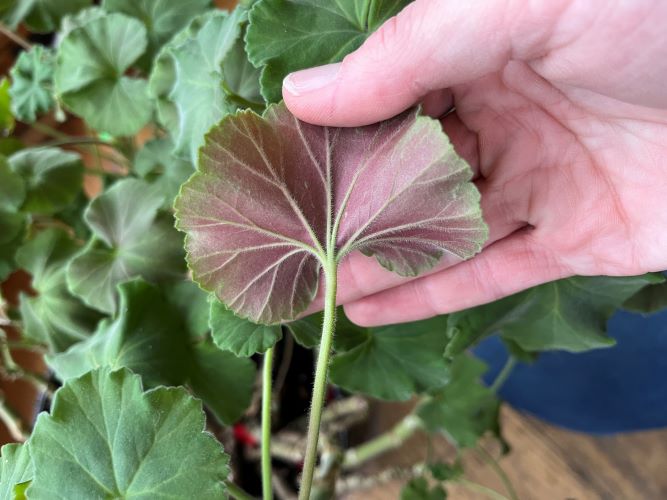
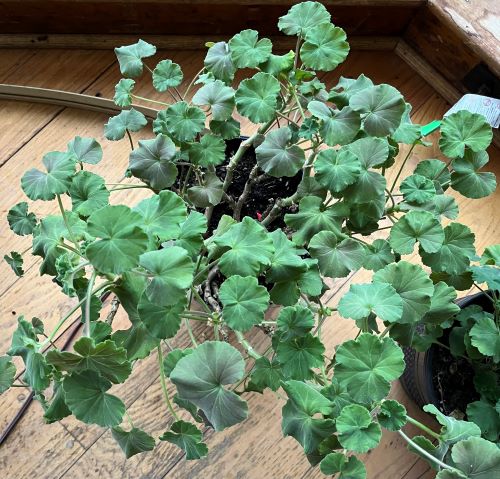
One of my geraniums looked different this week. The color just seemed off, especially compared to the others around it. Upon further inspection, I noticed the entire underside of many of the leaves are a purple color. I suspect phosphorus deficiency, as the roots look healthy. I am planning on fertilizing this plant during the next watering cycle.

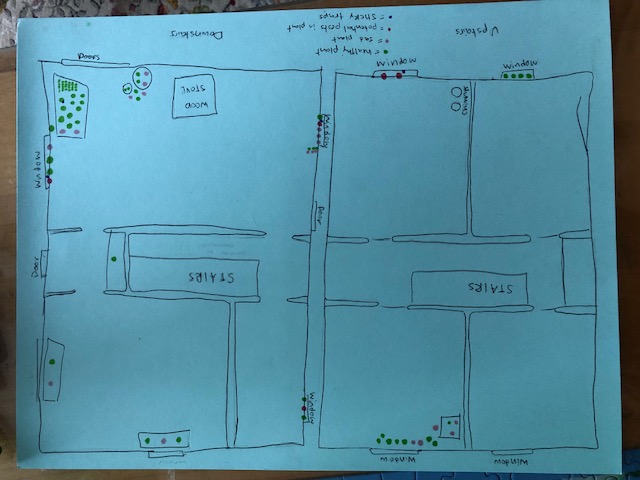
3. Since our greenhouse is currently still in the works of being built, I decided to draw up the schematics of where I think benches will be and which plants will be on them. Using this, I made a scouting plan.

For our first growing season, I am planning on overwintering Mums and Geraniums. These will be checked at least once a week and watered as needed, much like this winter. I will be sure to use sterile potting soil this time, though.

 In the spring, I will sow seeds of marigolds, zinnias, and coleus to plant around high use areas of Allegany State Park. The greenhouse being constructed is 48ft x 60ft, and I realize there may be a high point of entry for pests, due to its location. It Is in the middle of a woodlot and near a stream.

To scout, I would put sticky traps in each different type of plant. I would like to check these biweekly (or more frequent). Near the sides of the greenhouse, I suspect there will be a higher chance of pests and weeds coming in through the ‘roll up’ sides. Given this information, I feel it would be best to grow the marigolds and scented geraniums here, as they are hardier and can act as indicators for pests. When scouting for pests, I would spend much of my time here. However, this would be my last stop while scouting as they may be the most infested.

The inside benches will house coleus and zinnias. They will also be just as likely to harbor insects due to their location of a main walkway between both the front and back entrance.

At least one whole day a week can be dedicated to scouting for greenhouse pests, cleaning the greenhouse, pulling weeds, and checking up on plant health during peak season.


Attachment GreenhouseLayout.jpg
Attachment PurpleLeaf.jpg
Attachment PurpleLeaves.jpg
In reply to Tiffany Donaldson

Re: Week 5 Assignment

by Elizabeth Lamb -
Good scouting - to see the odd leaves and to identify a potential cause. Purpling of older leaves is indicative of phosphorus. You'd have to do tissue analysis to be sure. But fertilizing and then keeping track of the plant progress is good. The old leaves may not change color back but no more leaves will turn.
In reply to Tiffany Donaldson

Re: Week 5 Assignment

by Amy Howansky -
Tiffany,
Good idea to label the cards with an ID#. I found that if I took more than one card off of the stick at a time to bring them to the work/exam area, it was easy to mix up which card was which. Also, since mine were in a retail greenhouse, the employees told me that they sometimes had to move the cards, or that customers would move them, so it would be good to have the ID# on there to double-check the original location.
Amy
In reply to First post

Re: Week 5 Assignment

by Joseph Moreno -
1. In the specific greenhouse which was mapped there are only two areas where insects could be coming in from, and those are the two doors on either end of the greenhouse. These doors typically remain open all day long during warmer months and close in the evenings during the cooler months. Because the houses are plastic cold frames the side walls also are raised during the warmer months allowing any kind of pest to enter the houses from all sides.

2. The plants that were marked were sprayed with a preventative fungicide since last week. Other than that there has been no change with the plants. It's starting to get slightly warmer here in central North Carolina. Today we had a high of 72! So most of are plants are starting to come out of dormancy and I expect that pest pressure will soon increase as well so I plan to be extra vigilant about the timing about certain pests.

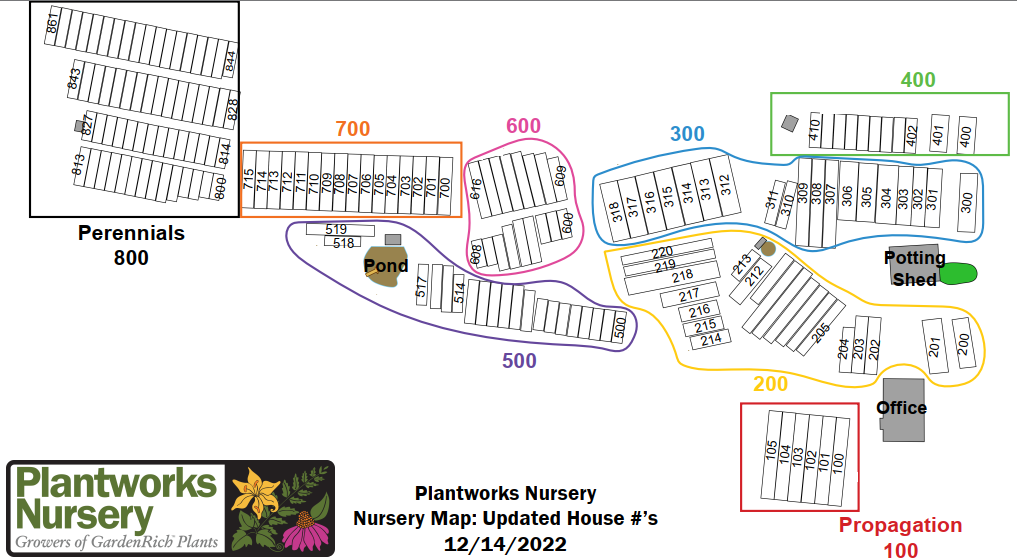
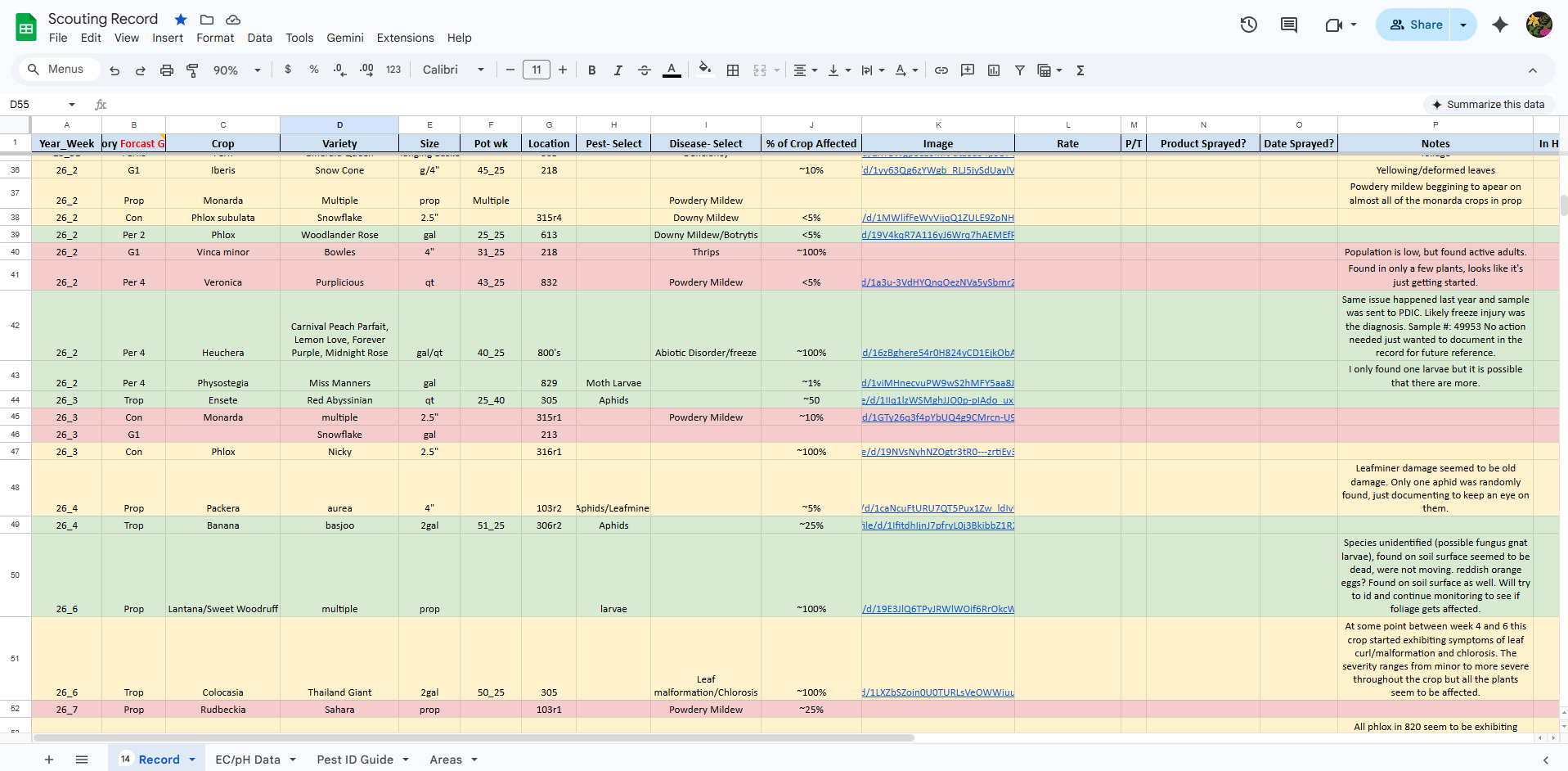
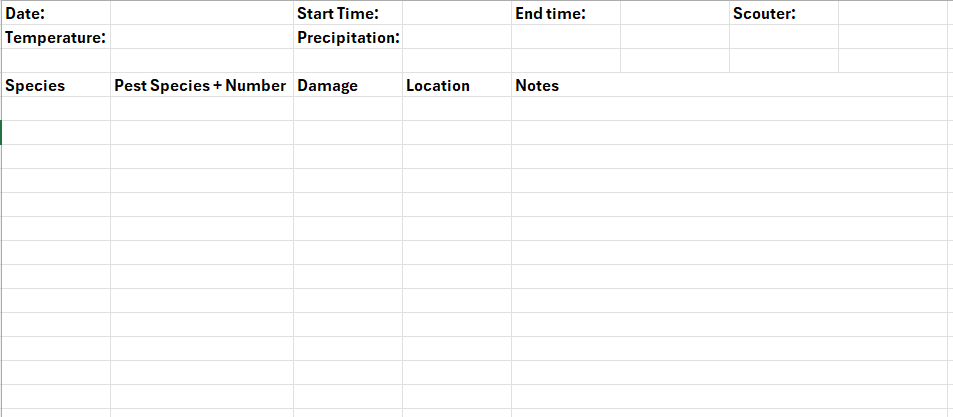
3. Below is the google spreadsheet that I use everyday at my job for scouting. I divide the entire nursery into five sections and scout in the houses of each section each day of the week. (Map of nursery below) This is my schedule: Monday: 800's, Tuesday 700's, Wednesday 600's & 500's, Tuesday 400's & 300's, Monday 200's and prop. As for my scouting record, I find that it works as a great tool of communication because I can link pictures of pests and then comment on the entry and the head grower will receive an email. Every Wednesday the head growers and I meet to review the scouting record during our IPM meetings. This allows for updates about spraying as well as informs other head growers about issues happening in other areas of the nursery. This has been especially helpful for letting head growers know when cuttings or plugs in prop have any issues that might be sent down to other houses after being potted.


In reply to Joseph Moreno

Re: Week 5 Assignment

by Elise Schillo-Lobdell -
Wow!, makes me tired just thinking about scouting that much! I love your notes and especially the column for % of crop affected.
In reply to Elise Schillo-Lobdell

Re: Week 5 Assignment

by Elizabeth Lamb -
We might well use your nurseries plan as an example in future classes! Thanks, Joseph!
In reply to First post

Re: Week 5 Assignment

by John Miller -
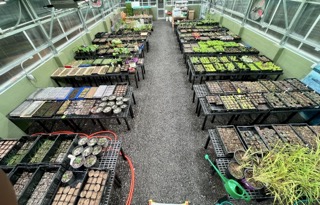
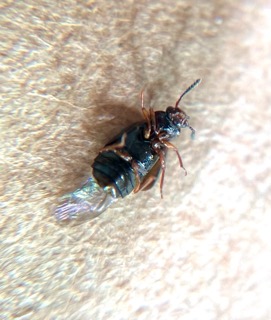
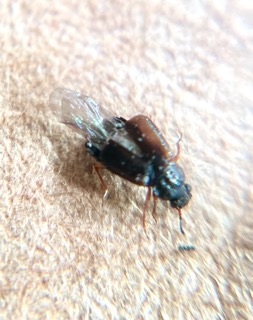
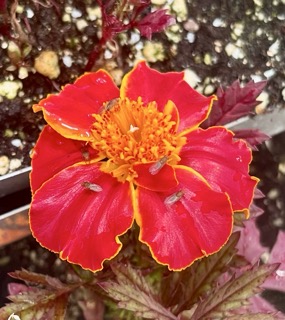
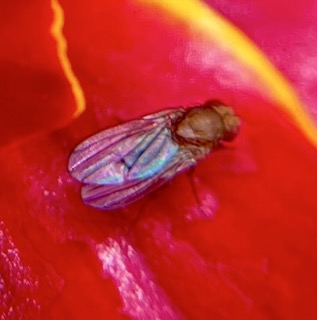
I've been seeing some fruit flies (I think) and they probably came in from a worm composting bin that I brought in out of the extreme cold a few weeks ago. I have also found a rove beetle (I think). The fungus gnat counts remain fairly low after applying nematodes a month ago, although I suspect that I will need to treat again because of adding so many new seedlings and untreated potting soil. Essentially, I "scout" every day in my 30x60 greenhouse, because I'm keeping a close eye on all the plants; it is my first half hour each morning. My sticky cards only have fruit flies, fungus gnats, and an occasional predatory wasp; I have one posted in each of the four quadrants. I have  
Attachment IMG_3741 Small.jpeg
Attachment IMG_3927 Small.jpeg
Attachment IMG_3928 Small.jpeg
Attachment IMG_3929 Small.jpeg
Attachment IMG_3930 Small.jpeg
In reply to John Miller

Re: Week 5 Assignment

by John Sanderson -
John, the fruit flies coming from decomposing worm compost makes sense. I don;t think they will cause any harm to your plants. I'm not sure that those are rove beetles. I can't quite tell from the photos the length of the elytra relative to the abdomen, and the wings are extended, not folded back under the elytra.
In reply to First post

Re: Week 5 Assignment

by Shawn Jenkins -
1. In my mapped greenhouse there are several entry points for pests. There is not much that can be done to improve it for scouting, the plants in the greenhouse are dispersed throughout as each bench is under the care of a student. As a reult the plant varieties are spread out amongst the house making it more difficult to scout specific plant types.
2. Marked plants are showing a sizeable increase in fungus gnats and thrips: a product of poor watering techniques (new/learning students) and the spread of affected plants being propegated and managed. Unfortunatly my job as a scout is just that, my grower (professor) tends to treat these issues as learning points and waits until the threshold is hit and then reacts. Plants are young so damage will most likely become more evident in the coming weeks.
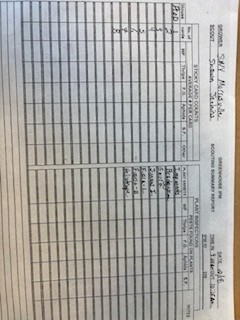
3.  I chose one of the scouting form examples from the list from week 2 because I think it works best for my uses with an ever changing greenhouse as far as plants and movement around the greenhouse space.  I listed the varieties we have now in our production house.  Currently it takes about 30-40 min to scout the greenhouse, when it fills up It will take 60-75 min to inspect it fully.  I scout every wednesdy right now, as the weather warms up and the plants develop I will begin scouting on Mondays and thursdays so if an application is needed I can make it on Fridays if possible for convenience to classes.Scout form
In reply to Shawn Jenkins

Re: Week 5 Assignment

by Elise Schillo-Lobdell -
Shawn - that is the form created by the Cornell IPM folks that I used for many decades, it served me well. Is the Professor willing to try more bio-controls?, if so, if you could get a boat-load of cucumeris in there and a few more weekly applications of nematodes you might not have to use pesticides on the thrips at all.
In reply to First post

Re: Week 5 Assignment

by Amy Howansky -
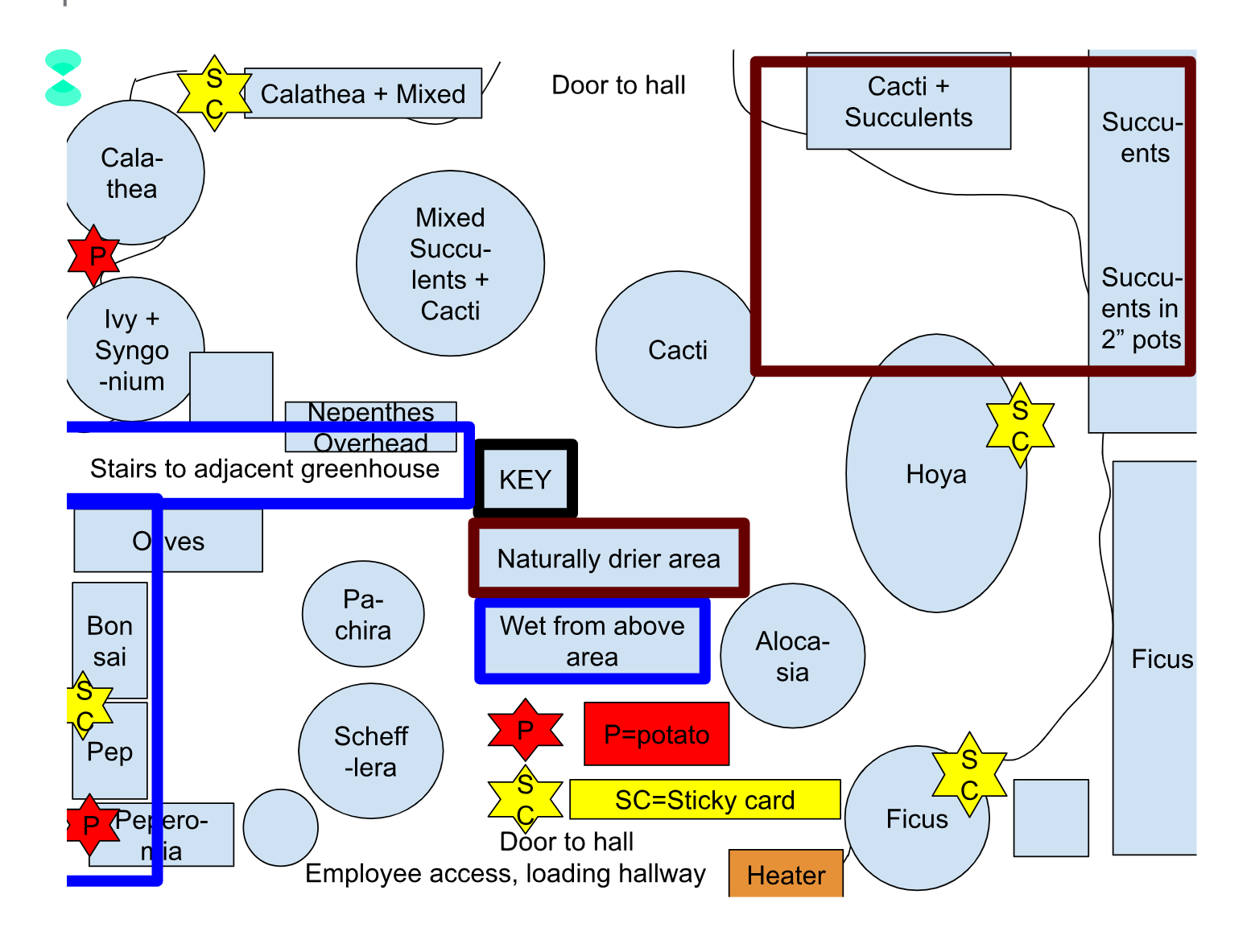
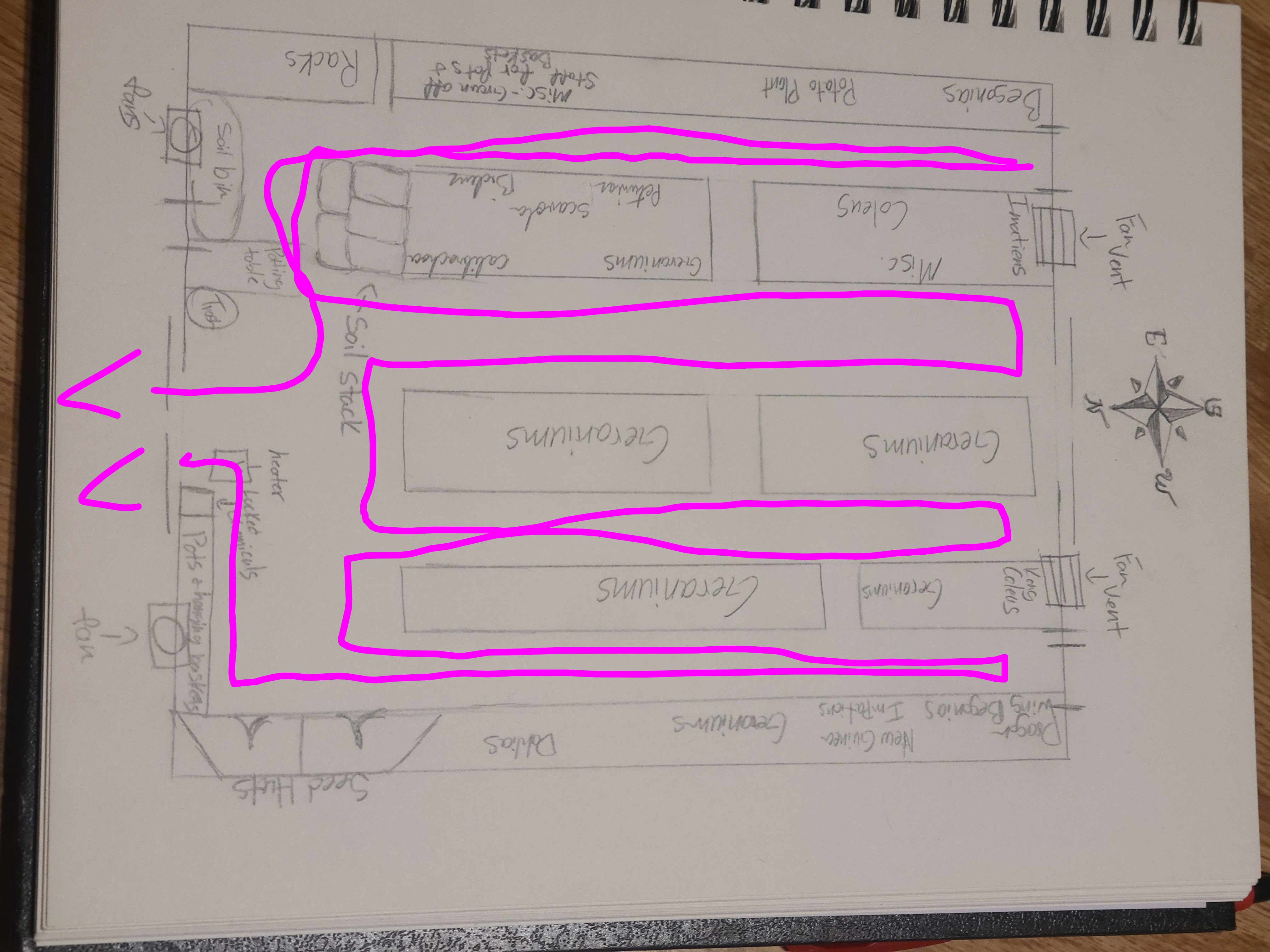
Map of greenhouse
Based on what we learned in class, I have added to the map:

An overall indication of the KEY since it was getting bigger and more complicated.
BLUE rectangles to mark areas of general wetness such as coming from a group of hanging baskets that make the walkway below wet, dangerous, and prone to algae.
BROWN rectangles indicating areas of general dryness due to sunlight, airflow, and lack of watering features and greenhouse water pipe structures.
More stars to indicate more sticky card placements.
An ORANGE rectangle to show the location of a heating unit.

I also indicated that the door at the bottom is an employee entrance and plant-loading access to the hallway, so lots of people, and plants, and garbage, and such, go through that area so it may be a gateway for outdoor pests to come inside.

I also included it as a file below.

I will do the other parts of the homework as separate posts because I can't upload all at the same time.


In reply to First post

Re: Week 5 Assignment

by Amy Howansky -

Part 2 of the assignment.  (I will add part 3 as a separate post.)
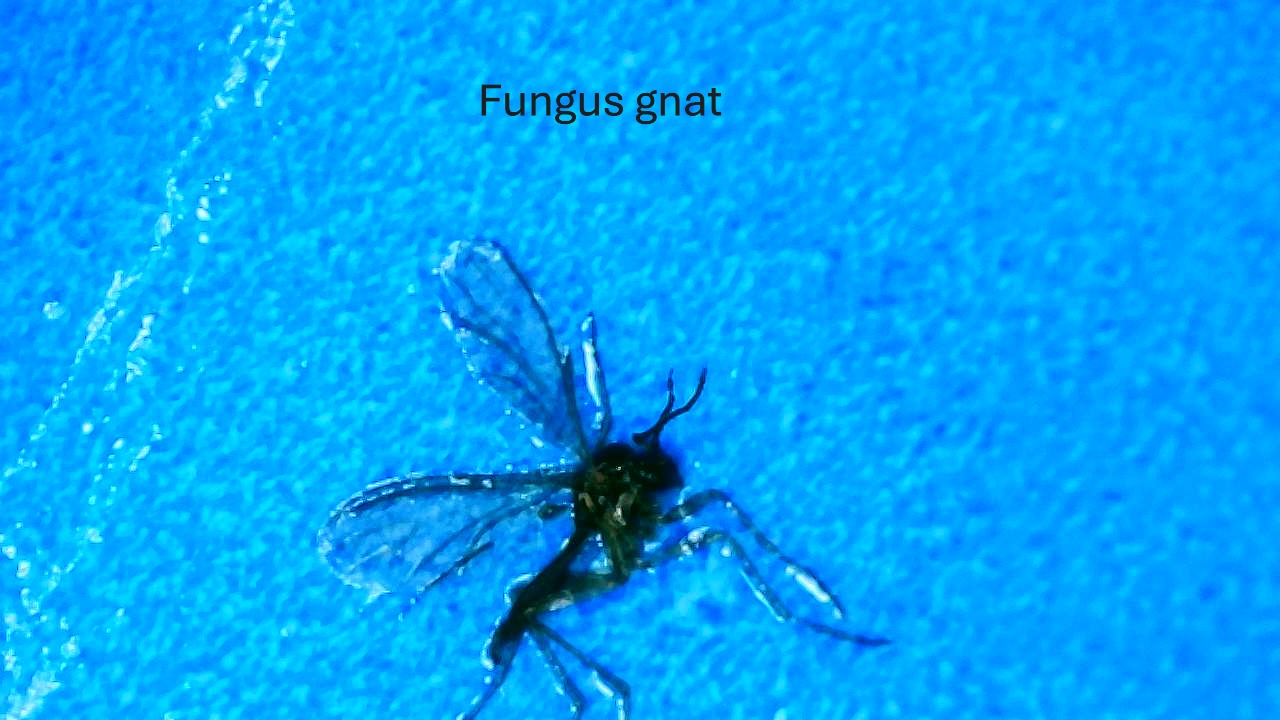
No management was done other than watering.  There has been no fertilizing because the plants get sold so quickly that they are not in the greenhouse long enough to get fertilized, and they come with slow-release fertilizer pellets already.


There was a big sale at this business between my scouting visits, so MANY people had wandered through, possibly bringing pests or diseases on their clothes from their plants at home.  Maybe?  


Also, because of the sale, as mentioned previously as a general problem for scouting…

Some of the plants that I had previously scouted ended up getting sold to customers.  So, I have had to rotate my sticky cards to different plants within the same type.

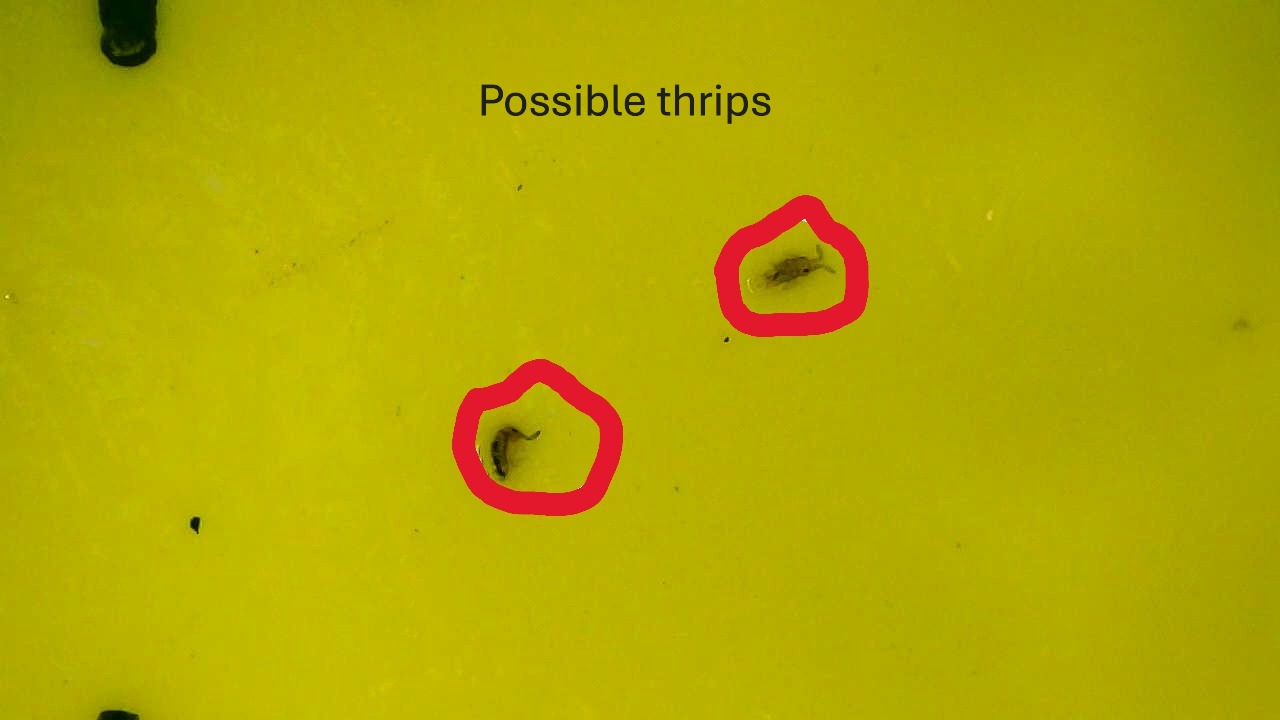
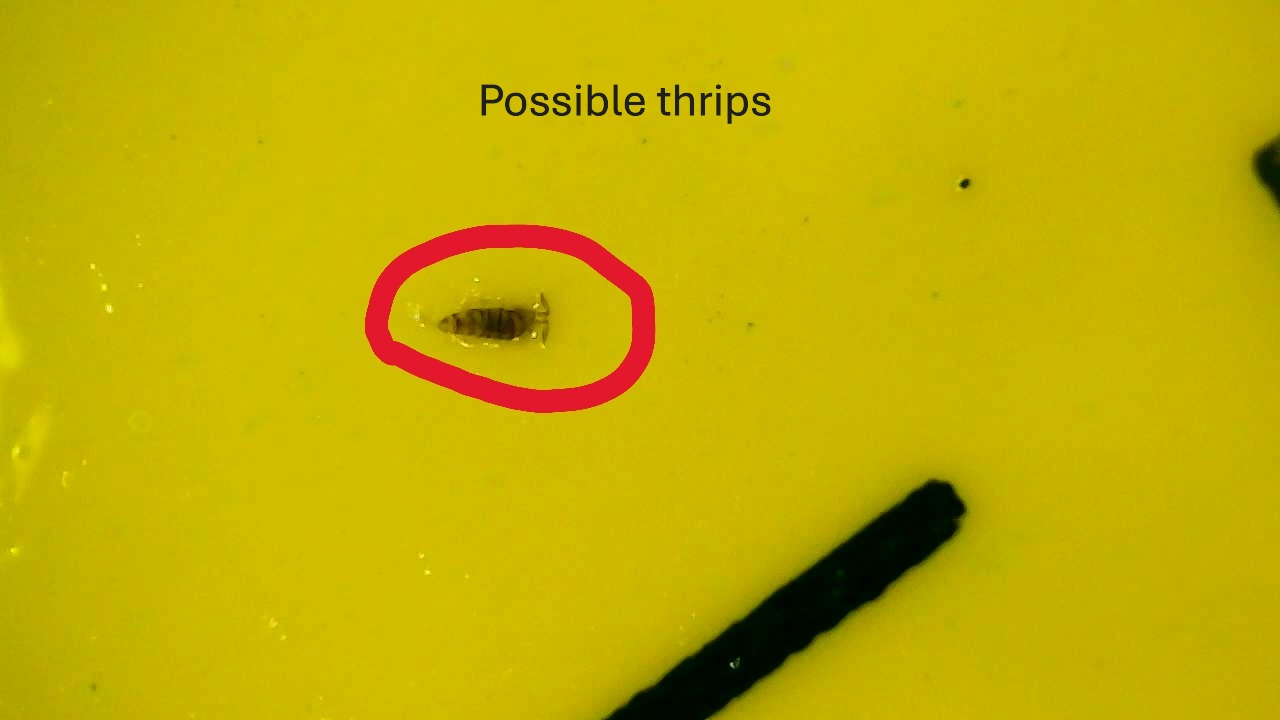
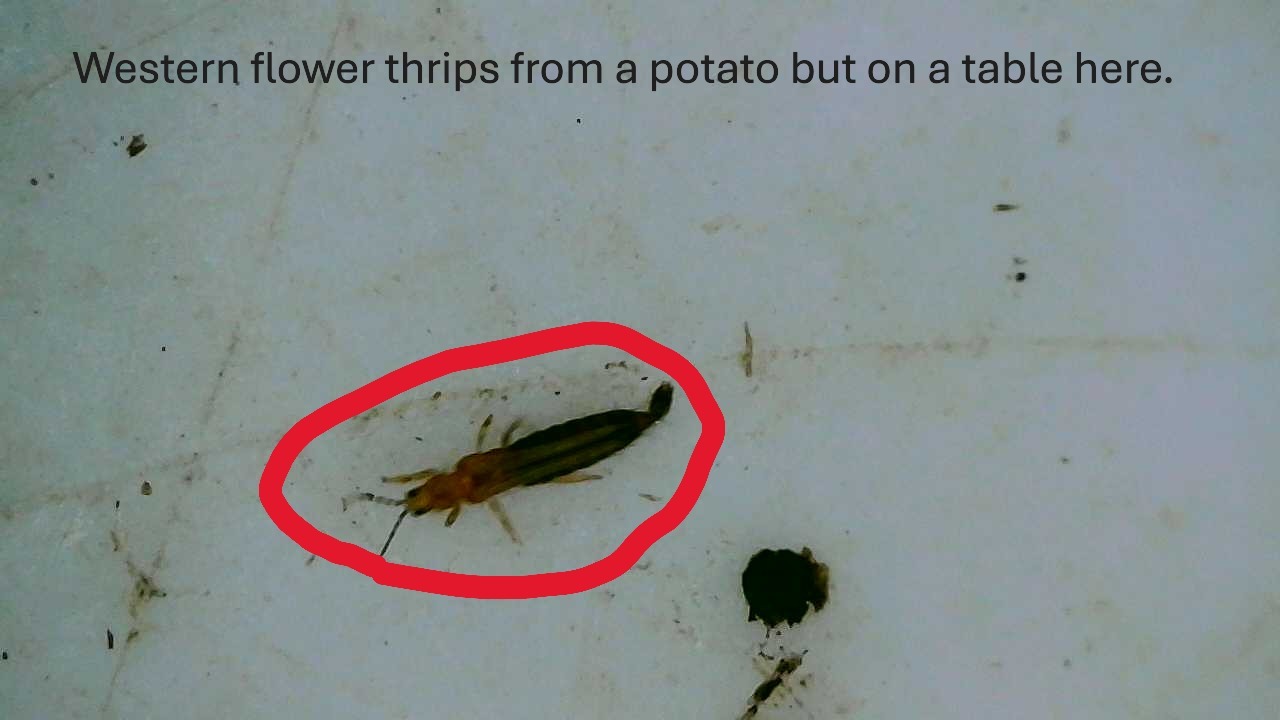
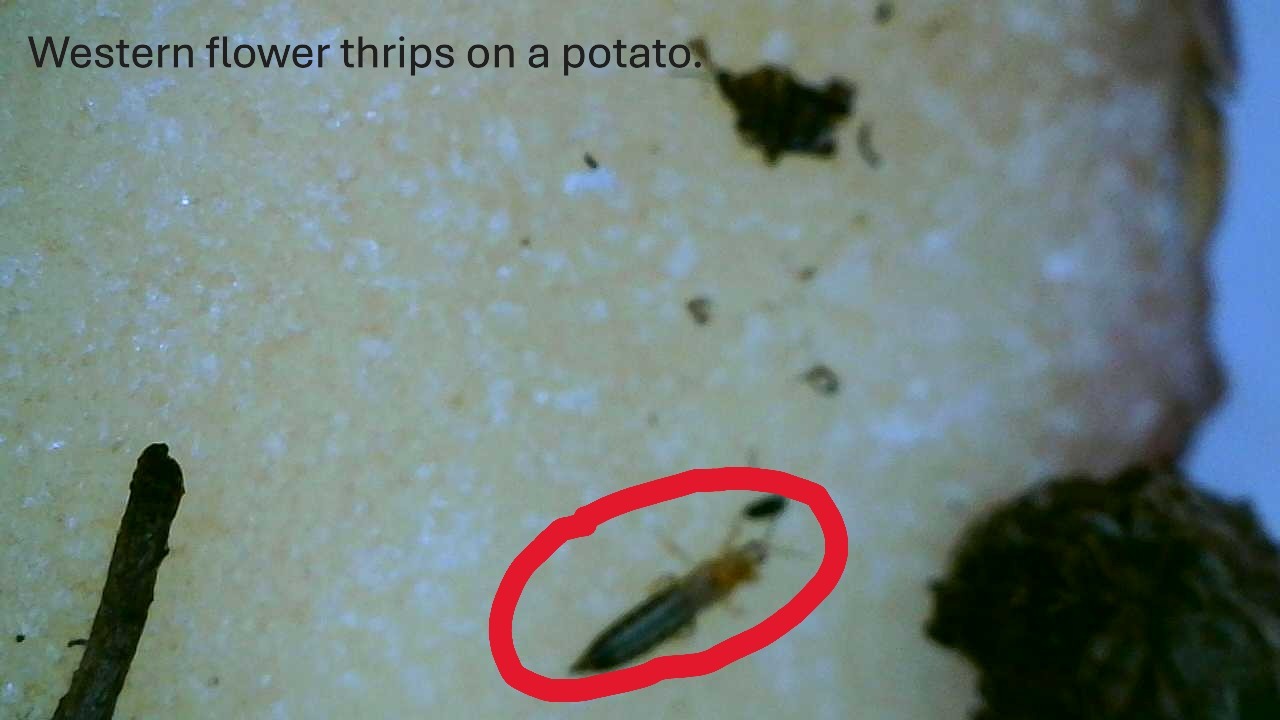
Here is a link to a video of a western flower thrips from a potato, but it is moving across a table here. (I actually couldn't access my own link, but I am leaving it up in case any of you can see it.  The original video was too large to upload.)

https://1drv.ms/v/c/d1d4dde8d25fbada/IQD1L_ThrMieT7841CatRYvYAURfkCV7O-drlLNVV2M7u4A?e=EAl8Sf
Attachment Fungus gnat on sticky card.JPG
Attachment Mealy bug on staghorn fern.JPG
Attachment Thrips on sticky card 2.JPG
Attachment Thrips on sticky card maybe.JPG
Attachment Western flower thrips on potato 2.JPG
Attachment Western flower thrips on potato.JPG