Submit Section 4.4 Assignment 5: Review Independent Study Guidelines (include attestation)
CGL2025 Independent Study
Guidelines and Acceptable Projects
The independent study project serves as a way for current cohort members to demonstrate their leadership ability, and apply tools that they learned throughout the year-long program. Participants will be assessed on their ability to design and implement a project that effectively involves community members, demonstrates creativity and problem-solving, and leads to measurable positive change.
General Overview
The Independent Study period will begin on June 9th and end on September 1st, 2025. During this time, participants will complete projects that further their gardening efforts and address community needs. These projects should be completed in three phases: planning, implementation and evaluation.
Planning – In the planning phase, you will develop a plan for the project, determine who will be involved and begin organizing the materials that you will need to have successful project. This can include facilitating meetings, conducting outreach, developing success metrics and developing materials that you will use during the implementation phase.
Implementation – This is the active phase of your independent study. In this phase you have begun the project and are tracking both the progress and impact of the project along the way. The implementation can be a series of engagements/workshops, a major workday, or using and sourcing feedback for any new materials that you develop for the project.
Evaluation – In the evaluation phase you will be evaluating the project for success. Participants are responsible for providing success metrics as part of the initial planning phase and the project proposal, during this phase you will be looking at the data you recorded during the implementation phase to determine if your project was successful. To complete this phase, you must mention how your project was successful and how you may build on this project in the future.
At the end of the program, participants will present their project to their cohort for feedback. Peer-to-Peer presentations will take occur between November 3rd-13th, 2025; participants are responsible for scheduling their own presentations, and attending 2 of their peer’s presentations via a sign-up sheet.
Certificate Qualification and Completeness
Each participant can earn up to 16 points for independent study projects, based on criteria outlined in the scoring rubric. Participants must earn 10 of the 16 available points to achieve certification. The four elements that will be ranked are stakeholder engagement, community impact, garden sustainability and the peer-to-peer presentation:
Stakeholder Engagement - An element of your project meaningfully engages your community garden stakeholders. For this project, stakeholders include neighbors, partners, volunteers, members or other garden leaders.
Community Impact/Responding to Community Need - Your project should be inspired by and respond to the needs of your local community that you identify in you project proposal, and address throughout the independent study.
Garden Sustainability - Your project should contribute to the sustainability of your community garden. Consider these two questions: How are you telling the story of your community garden and How am I making my garden more resilient/sustainable with this project? Your independent study should be mission-aligned and highlight the benefits of your community garden as well as encourage more community support for your garden initiative (advocacy, interaction, funding, etc.)
Peer-to-Peer Presentations - The peer-to-peer presentations are an opportunity to share your project with other members of your cohort. Your presentation should be complete with graphics or images, and include details about the planning, implementation and evaluation phases of your independent study projects. Written feedback about the presentations will be given to all participants by the last day of class, December 19th.
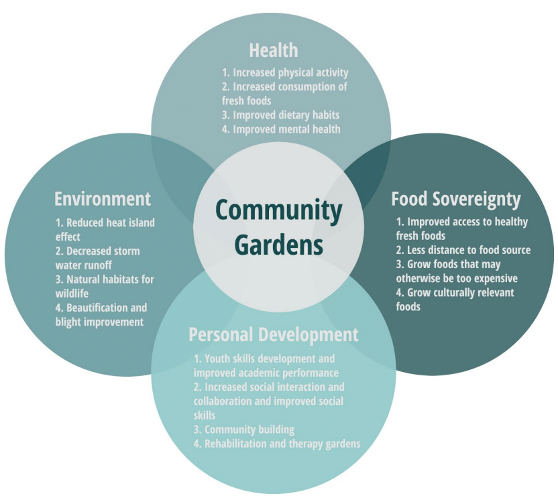
* Figure 2. Diagram of the benefits of community gardens from New York State Department of Agriculture and Markets 2023 Community Garden Taskforce Report
Community gardens provide several benefits to the neighborhoods they serve and the individuals that steward or engage with the garden. Your project proposal must consider the benefits that community gardens provide, and provide a detailed outline of how your independent project will improve your garden’s impact. A complete project proposal should be no more than two (2) pages, and include the following:
- Project Title
- Neighborhood information (including demographic data)
- Garden Information (brief garden history, including purpose statement, think boilerplate)
- Proposed Topic
- Identify community need, stakeholder groups or organizations, and community resources you plan to engage
- Outline of Actions that you will take during the three phases (planning, implementation and evaluations)
Project Proposal Topics (Examples):
Language Translation and Interpretation – an initiative that makes signs, garden handbooks/policies and workshops available in multiple language.
Green Infrastructure – an initiative that improves the gardens capacity to perform ecosystem services functions
Fundraising and Partnerships – an initiative that focuses on the gardens ability to qualify for funding opportunities and engage local organizations
Skills-based training – an initiative that focuses on expand the knowledge base of new or inexperienced gardeners, community members, and volunteers to improve their experience at the garden
- 4 April 2025, 10:50 AM