Topic outline
-
Master Gardener Volunteer Program Mission
We prepare volunteers to be peer educators who build relationships with community audiences to integrate local experience and research based knowledge in planning for and initiating steps to manage gardens, lawns, and landscapes with an emphasis on food security and environmental stewardship.
Master Gardener Volunteer Program Vision
Adults, youth, and families who engage in our garden-based educational programs expand their learning networks and ecological gardening skills towards greater resilience and connections. As a result, they experience enhanced health and wellness, food security, ecological literacy, environmental stewardship, and they embrace sustainable community practices.
-
-
Please sign-up for your Final Presentation date and time slot. No worries if you haven't picked a topic yet, they are due at our May Class.
-
Monday, May 13, 2024
Topics of the Week:
- Entomology
-
For this week's forum post, tell us about your favorite insect to hate.
- Common Name
- Scientific Name
- Order
- Mouthparts (i.e. biting/chewing, sucking/piercing, etc.)
- Why you hate them so...
-
Monday, May 20, 2024
Topics of the Week:
- Vegetable Garden Pests
-
Monday, May 27, 2024
Topics of the Week:
- Pests of Ornamentals
-
This website has a photo gallery and links to fact sheets of insects found in:
- Lawn / Grassy Area
- Trees and Shrubs
- Roses and/or Other Flowers
-
Monday, June 3, 2024
Take some time to go through what you learned since our last class and come to this weeks class with any questions you have. -
Saturday, June 8, 2024
Topics of the Week:
- Entomology
- Why We Identify Insects
- Insect Key Activity
- Natural Enemies - Predators and Parasitoids
- Jeopardy
- Entomology
-
Monday, June 10, 2024
Topics of the Week:
- Pests In & Around the Home
-
Please read the first ten pages of Management of Pest Insects In and Around the Home. This includes:
- Proactive Pest Management
- Reactive Pest Management
- Hiring a Professional Pest Management Company
-
Honey bee health is a critical issue today. The Department of Agriculture and Market's Division of Plant Industry strives to assist beekeepers in maintaining their colonies in a healthy condition. Through inspection, certification, education, and outreach to beekeepers, the Division works to ensure the health of honey bees. As of December 23, 2021, all beekeepers in New York State are required to register with the Department of Agriculture and Markets and to renew their registration annually. Beekeepers must also indicate if they intend to sell nucleus (nucs) colonies.
-
Monday, June 17, 2024
Topics of the Week:
- Plant Pathology
-
A great tool to help diagnose problems in the yard and garden caused by insects, diseases, and nonliving factors.
-
View Start discussions: 1
Read the above page on 'Beech Leaf Disease - Invasive Species Center'.
Most often humans are responsible for the spread of plant diseases meaning that spread of many diseases could be prevented by restricting and/or regulating the movement of plants, firewood, and wood products. Did you know that in the state of New York, it is illegal to transport untreated firewood more than 50 miles from its source within New York State? It is also illegal to bring untreated firewood into New York State. Click here to learn more. Regulations like these are commonly disregarded.
In this weeks forum post, thinking about plant diseases and their economic, ecological, and social effects, as well as the role humans have in their dispersal:
- What can you do in your personal life to increase awareness among your family and friends?
- What can we do as Master Gardener Volunteers to increase public awareness?
- What other things do you think can and should be done by other organizations?
- Check out the Don't Move Firewood campaign.
- Check out how the NYS DEC is tracking Beech Leaf Disease.
- Check out the Don't Move Firewood campaign.
-
Monday, June 24, 2024
Topics of the Week:
- Introduction to Invasive Species
- Invasive Plants
-
Authorities in New York prohibit the movement of all types of untreated firewood into the state from outside sources. Untreated firewood originating in New York may not be moved more than 50 miles within the state. In New York, firewood is considered “treated” only if it has met the following conditions:
- it has been heat-treated to 71° C (160° F) for 75 minutes
- it is labeled as “New York Approved Heat-treated Firewood/Pest Free” with the producer’s name and address
-
Sit back, relax, and enjoy the fireworks!
-
Class # 7 - Warwick Community Garden, Invasive Species Scavenger Hunt, and Cultivating a Community of Belonging
Saturday, July 13, 2024
Topics of the Week:
- Community Gardens
- Orchard Management
- Vegetable Garden Management
- Invasive Species Scavenger Hunt
- Cultivating a Community of Belonging
- VIDEO: These Gardens are Blueprints
- Presentation
- Who is gardening?
- Who lives in Orange County?
- Who are we, the Master Gardener Volunteers?
- Who am I?
- ACTIVITY: Social Identity Wheel
- ACTIVITY: Move into the Circle
-
Take a 15-20 minutes to complete your own social identity wheel. Then take a few minutes to read and think about the questions at the bottom of page 3.
- Community Gardens
-
Monday, July 15, 2024
Topics of the Week:
- Implicit Bias Training
-
Monday, July 8, 2024
Take some time to go through what you learned since our last class and come to this weeks class with any questions you have. -
Monday, July 22, 2024
Topics of the Week:
- Keystone Native Plants
- Native Plants for Birds
- Native Plants for Pollinators and Beneficial Insects
-
Monday, July 22, 2024
Topics of the Week:
- Invasive Species and Stages of Management
- Invasive Invertebrates
- Prevention
- Eradication
- Containment
- Management
-
Invasive Species and Stages of Management
Prevention is the most effective and low-cost solution for managing invasive species. Waiting until an invasive species is established to start management is costly and can harm valuable infrastructure and the natural biodiversity needed for healthy ecosystems.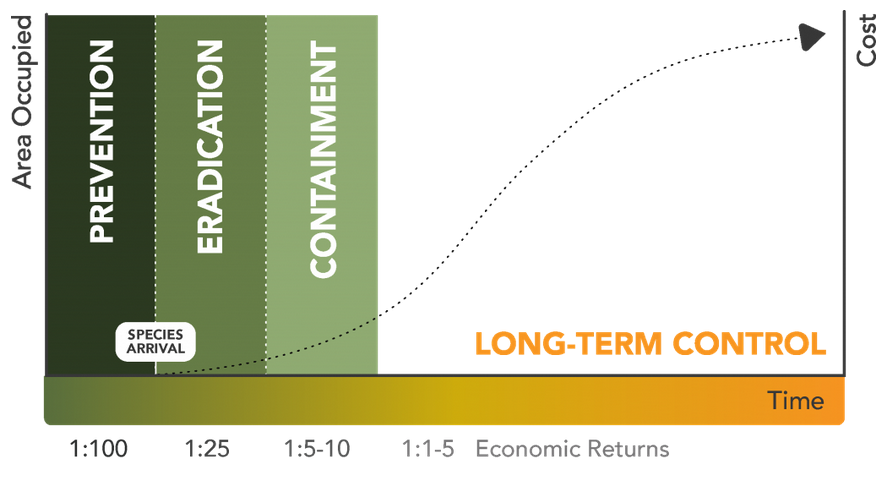
The invasion curve shows the stages of invasive species management from pre-arrival (prevention) to long-term control. After a species is introduced, management costs increase and likelihood of eradication decreases as time passes.
- Prevention: The most cost-effective solution for managing invasive species. Public awareness is essential for this stage.
- Eradication: Removing a species population in its entirety. If populations are localized, eradication is possible.
- Containment: Reducing further spread of an introduced species. As populations increase, eradication becomes increasingly unlikely and priorities shift to preventing further spread.
- Long-term control: The most costly stage of invasive species management. Eradication is unlikely to impossible and we instead focus on limiting populations and protecting remaining resources.
Investing in prevention provides economic returns up to 100x higher than trying to manage a species after it arrives.
-
It's up to each of us to stop hungry pests.
-
Learn how hungry pests get around and what you can do to stop them.
-
Learn how you can do your part and leave hungry pests behind.
-
Authorities in New York prohibit the movement of all types of untreated firewood into the state from outside sources. Untreated firewood originating in New York may not be moved more than 50 miles within the state. In New York, firewood is considered “treated” only if it has met the following conditions:
- it has been heat-treated to 71° C (160° F) for 75 minutes
- it is labeled as “New York Approved Heat-treated Firewood/Pest Free” with the producer’s name and address
-
Pay close attention to the section entitled "What you should do" to learn how you can help prevent the spread of jumping worms.
- Invasive Species and Stages of Management
-
Monday, August 5, 2024
Take some time to go through what you learned since our last class and come to this weeks class with any questions you have. -
Saturday, August 10, 2024
Topics of the Week:
- Natives versus Nativars
- DEIB Best Practices: Working with Diverse Populations and Microaggressions
- Floral Arranging
- Weeds
-
Includes a recipe for homemade flower preservative.
- Natives versus Nativars
-
Monday, August 12, 2024
Topics of the Week:
-
Wildlife Management
-
Wildlife Feeding is ILLEGAL for deer, bear, and moose in New York State.
-
This book is designed to help anyone manage wildlife problems by proposing solutions based on the principles of integrated pest management (IPM). Homeowners, Master Gardeners, farmers, golf course managers, park and landscape managers, will all find the information useful.
This book covers the basic knowledge needed to effectively deal with a variety of wildlife issues. It focuses on techniques appropriate for people without a state license. For the most part, only methods suitable for non‐professionals dealing with human‐wildlife conflicts have been included. Fortunately, anyone who needs to resolve wildlife conflicts can follow the fundamental principles of wildlife damage management using IPM for birds and mammals.
-
This folder contains individual fact sheets for:
- bats
- black bears
- crows
- deer
- geese
- moles
- raccoons
- snakes
- striped skunks
- tree squirrels
- voles
- woodchucks (groundhogs)
- woodpeckers
-
Wildlife Management
-
Monday, August 19, 2024
Topics of the Week:
- Pollination
- Pollinators
- Attracting, Conserving, and Protecting Pollinators
-
Connect with local beekeepers who can safely capture, remove, and relocate honey bee swarms.
-
As of December 23, 2021, all beekeepers in New York State are required to register with the Department and to renew their registration annually.
-
Monday, August 26, 2024
Topics of the Week:
- Top Ten Lawn Questions
- Sustainable Lawn Care
- The Truth about No Mow May!
-
Photo gallery of common lawn weeds.
-
View Start discussions: 1
Many homeowners are not willing to part with their lawn; others may be willing, but are required to have a lawn by the homeowners association in their neighborhood. Many lawn inputs, especially if used improperly, are not environmentally friendly (i.e. mowing, watering, pesticides, fertilizers, etc.).
What do you think is the MOST IMPORTANT advice you could give someone who is not willing and/or able to part with their lawn, but would like to limit their environmental impact?
Some things to think about include:
- Turf Varieties
- Mowing Schedule
- Watering Schedule
- Fertilizer Use
- Pest Management
-
Catch up, work on your presentation, and enjoy the cool weather!
-
Monday, September 9, 2024
Take some time to go through what you learned since our last class and come to this weeks class with any questions you have. -
Saturday, September 14, 2024
- Asexual Plant Propagation
- Ask a Master Gardener Tables
- Final Presentations
-
Includes a list of plants and the types of tissue you can use for propagation.
-
Monday, September 16, 2024
Topics of the Week:
- Planting Trees
- Bare Root
- Containerized
- Balled and Burlapped
- Tree Care
- Transplant Shock
-
We do NOT make recommendation for specific arborists, but we do recommend that people find a certified arborist and this is website makes it easy - treesaregood.org
-
Planting the biggest tree you can afford is not always the best option. Though it is true 2” to 4” caliper trees give an instantly-landscaped look to homes, these trees are more prone to transplant shock and water stress. Transplant shock occurs from the loss of root system when the tree is dug from the nursery. As much as 95% of the plant’s roots may be removed during the digging process. This means fewer roots are available to provide water to the many branches and leaves. Symptoms range from scorch on the edges of leaves, dieback in the crown, increased vulnerability to diseases, insects, and drought, or tree death. Transplant shock, more or less, continues until the tree canopy and tree roots come into balance. For comparison, a 1” caliper tree planted with 5% of its root mass, provided good care, can recover 100% of its roots by the end of one year. A 4” caliper tree planted with 5% of its root mass, will take five years to recover 100% of its root mass. During this time the smaller caliper tree may easily catch up in size to the larger tree.
- Planting Trees
-
Monday, September 23, 2024
Topics of the Week:
- Landscape Design
-
Monday, September 30, 2024
Topics of the Week:
- Landscaping for Energy Conservation
- Water-Wise Gardening
- Landscaping for Energy Conservation
-
Sunday, October 13, 2024
Topics of the Week:
- Landscape Design
- Final Presentations
- Landscape Design
-
Monday, October 7, 2024
Take some time to go through what you learned since our last class and come to this weeks class with any questions you have. -
Monday, October 14th
Topics of the Week:
- Climate Change
-
New York State is embarking on a transition to an inclusive clean energy powered economy. All residents, businesses and communities across the State will have access to new opportunities to benefit from this transition including clean energy careers, home improvements, even rebates for businesses and personal transportation. But there’s a lot of information out there, and people may not know where to start.
To help New Yorkers access and navigate these opportunities, NYSERDA created the Regional Clean Energy Hubs. Clean Energy Hubs connect people to the clean energy economy.
The Mid-Hudson Regional Clean Energy Hub is your team of trusted, knowledgeable, community-based organizations from across the region and is a collaboration of Cornell Cooperative Extension of Dutchess, Sullivan, Orange, Putnam, Rockland, and Ulster, in partnership with Sustainable Westchester, New Yorkers for Clean Power, and a growing network of local partners.
-
This compilation of videos by Dr. Walter Jahn, a professor of biology at SUNY Orange, talks about the science behind climate change.
- Climate Change
-
Monday, October 21st
Topics of the Week:
- Phenology
- Growing Degree Days
-
Monday, October 28th
Topics of the Week:
- Spotted Lanternfly
- Tree-of-Heaven
-
Note that pesticide regulations vary from state to state so all of the insecticides mentioned in this video may not be available for use in New York. See resources below for information on insecticides available for use in New York State.
-
Note that pesticide regulations vary from state to state so all of the insecticides mentioned in this video may not be available for use in New York. See resources below for information on insecticides available for use in New York State.
-
Monday, November 4th
Topics of the Week:
- Ticks and Tick-borne Diseases
- Ticks and Tick-borne Diseases
-
Saturday, November 9, 2024
Topics of the Week:
- Volunteer Opportunities
- Final Presentations
- Volunteer Opportunities
-
-
Your final exam is due by Monday, December 2nd @ 7:00 am.
Good Luck!