Section M2.3: Adversity Quotient and LEAD Framework
Emotional Quotient (EQ) and Intelligence Quotient (IQ) are both widely recognized as key determinants of success, with EQ influencing interpersonal relationships and self-awareness and IQ reflects cognitive abilities and problem-solving skills (Stoltz, 2006). However, neither EQ nor IQ alone guarantees long-term success, as individuals with high intelligence or emotional awareness may still struggle when faced with significant obstacles. Adversity Quotient (AQ) is different because it measures a person’s ability to persevere through challenges, adapt to difficult situations, and transform adversity into opportunity (Stoltz, 2006). Unlike IQ and EQ, which focus on static traits, AQ determines how effectively an individual responds to setbacks, making it the most powerful predictor of sustained success in both personal and professional life.
The Adversity Quotient, as defined by Paul Stoltz first in 1997, is a measure of an individual's ability to withstand, adapt to, and overcome challenges. Since, AQ is now widely accepted as one of the most accurate measures of success because it assesses how well a person responds to adversity and is built on four dimensions, C.O.R.E :
C - control. Control refers to the extent to which a person believes they have influence over a situation or challenge. Individuals with a high sense of control are more likely to take proactive steps to improve circumstances rather than feeling powerless.
O - ownership. Ownership reflects the degree to which a person takes responsibility for their response to adversity. Those with high ownership do not blame external factors but instead take accountability for finding solutions and overcoming difficulties.
R - reach. Reach measures how far one allows adversity to affect other areas of one's life. People with low reach contain problems within their specific context, while those with high reach allow challenges to negatively impact multiple aspects of their life.
E - endurance. Endurance is the perception of how long adversity will last. Those with high endurance see difficulties as temporary and manageable, while those with low endurance view challenges as permanent and insurmountable.
A high AQ is crucial for leaders as it determines resilience, problem-solving ability, and long-term success in dynamic environments (Stoltz, 2006). For example, in a community garden setting, leaders with a strong AQ can navigate unexpected issues such as climate changes, resource shortages, or declining volunteer engagement by staying solution-focused and motivating others. By fostering a culture of persistence and adaptability, individuals and teams with a high AQ can turn obstacles into opportunities for growth and innovation.
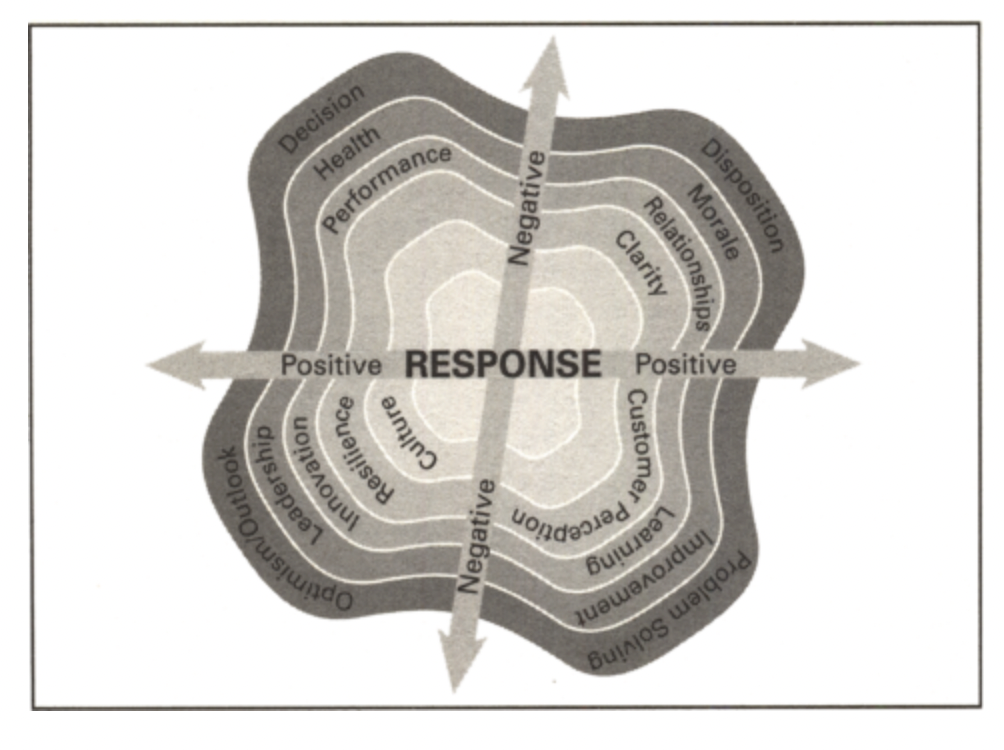
Image: Reproduced from Stoltz, P. G. (2006). Exhibit 5.3. The Adversity Quotient @ Work: Make Everyday Challenges the Key to Your Success--Putting the Principles of AQ into Action. HarperCollins to meet Moodle formatting requirements.
In Assignment 2 for this section, you will complete a questionnaire to assess your current AQ by determining your C.O.R.E. adversity response profile score. The response to one’s initial CORE score usually has a ripple effect (See image above) on one’s psyche where this score becomes rooted in your mind as a truth and may be discouraging at first. However, whether you scored in the highest percentile or lowest percentile, practice with the LEAD sequence can help you build your AQ or maintain resilience as a leader (Stoltz, 2006).
The LEAD (Listen, Establish Accountability, Analyze the Evidence and Do) sequence offers four steps for leaders to take when faced with adversity or disappointment (Stoltz, 2006). This sequence should be treated like a practice, where you eventually build a habit of taking a moment to stop and build situational awareness so you can respond confidently and appropriately.
Listen – The first step involves recognizing and acknowledging your response to adversity and your CORE. It requires You to be aware of their internal thoughts and reactions to challenges, and help you identify negative patterns that may hinder their response.
Establish Accountability – This step encourages you to examine the situation to identify where you may be able to take responsibility for the situation, and identify potential solutions rather than react impulsively by assigning blame to other contributors. A common impulsive reaction from leaders is accepting too much responsibility, even for factore beyond their control, and trying to single-handedly rectify the entire situation. By slowing down, leaders get a chance to influence future action and strengthen the ‘O’ of CORE without taking on too much additional stress.
Analyze – At this step, individuals assess the situation using the ‘C.R.E.’ of CORE to determine the best course of action. When assessing the situation for potential impact, ask yourself the following three questions: what evidence suggests this has to be out of my control ‘C’, what evidence suggests that this has to be far reaching ‘R’, and what evidence suggest that this has to last a long time ‘E’. Breaking down the challenge and asking these questions enable leaders to reframe their approach and develop a constructive response.
Do – The final step is about taking action. It requires individuals to implement their plan, adjust as needed, and remain persistent in overcoming adversity. This step reinforces resilience and strengthens overall AQ over time.
Next, do 2.3 Assignment 2: The Adversity Response Profile