Required Textbook, Materials and Supplies
Required Texts
We will be using the 2023 Edition of the Encyclopedia of Landscape Design: Planning, Building and Planting Your Perfect Outdoor Space by Chris Young (published by DK) for our main text. There will be chapters assigned with lessons as we move through the course. Keep in mind that earlier versions do not align well with this course. This is available for purchase online and at bookstores. Also available through this Bookshop affiliate link.
This is a digital download: Site Assessment for Better Gardens and Landscapes, Charles P. Mazza
Optional Reading
A list of optional books to be used with this course can be found in the 'Additional Resources' topic at the end of the course. These are books we have really enjoyed and urge you to explore as you continue to develop your garden after the class is finished. Also, several lessons have additional information supplied in the form of downloadable PDFs.
Required Materials
You will be sketching and drafting garden designs by hand, with templates, paper, overlays, colored markers, pens, and pencils. Google maps and surveyor maps of your property are helpful to have to create your base map, then you will use overlays of tracing paper to sketch ongoing assignments. However, if you are more comfortable using a CAD program, design app, or other digital method, you are welcome to use that for drafting process and final design. Feel free to use a combination of both.
All of these items should
be available at your local art store or online:
- Tracing paper that is no more than 8 1/2 inches on one end, unless you plan on doing very large drawings.
- Drawing or sketch paper. Paper size depends on the size of your garden area. You will be using a scale of 1" = 4', so an 11" x 14" paper will accommodate a garden of approximately 44' x 56'.
- Grid Lined (graph) Paper (letter or legal size). This will help drawing your site plans to scale.
- A designated garden notebook as a place to store ideas, plant lists, budget items, prices, and observations.
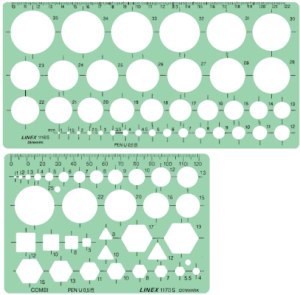
- Circle template with a good variety of sizes, one with extremely large circles may not be needed, and you can use a drawing compass for very large circles. This will be crucial when you when you draw plants on your plan.
- Set of Colored Pencils or Markers
- Black Sharpies: one thin and one thick will usually cover all your needs.
- A computer with reliable high-speed Internet access (to view videos, view readings, submit assignments, and participate regularly in discussion forums).
Optional Materials
- Clipboard: Optional but helps taking notes and drawing outside.
- Digital camera or a film camera: digital will make turning in assignments a lot easier.
- French
Curve:
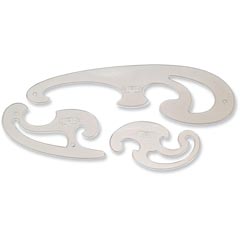 This will help you if you want to design a less formal garden and plan on drawing
any curves. Just line up the edge on whatever you are drawing, it may take a
few lines and moving it around but you can craft almost any shape you want with
one of these. Get a smaller one rather than a larger one since most of your
drawings will be on 8 1/2 by 11" paper.
This will help you if you want to design a less formal garden and plan on drawing
any curves. Just line up the edge on whatever you are drawing, it may take a
few lines and moving it around but you can craft almost any shape you want with
one of these. Get a smaller one rather than a larger one since most of your
drawings will be on 8 1/2 by 11" paper.
Materials Needed for Site Assessment
Step 1: Garden or Landscape Area
- Retractable 25’, 50’ or 100’ measuring tape; or yardstick
- Roll of flagging tape (old grocery store vegetable bags cut in strips will work)
- A directional compass (optional)
Step 5: Wind
- Roll of flagging tape (old grocery store vegetable bags cut in strips will work)
- 10 sticks or poles at least 2 feet long
- Kitchen Timer
Step 6: Compaction
- Long handled pointed blade shovel
- Masking tape
- 10-25 sticks (wooden skewer sticks, for instance)
Step 7: Drainage
- Empty 11 - 16 oz. coffee can or similar sized can and Can opener
- Ruler
- Wooden board - 1-2 ft. long (optional)
- Plastic sheet or large bucket
- A garden hose (or watering can)
Step 8: Soil Characteristics
- Pint-sized glass jar with tight fitting lid
- Powder dishwasher detergent
Step 10: Wildlife Interference
- Pieces of roofing shingle or small wood boards