
Beech Leaf Disease
American beech trees and sugar maples are the two dominant trees of the northern hardwood forest. American Beech trees are present in most counties in New York state, from sea level in coastal Long Island northward. Click here to learn more about the American Beech. There is a new disease threatening our beech trees — beech leaf disease. Beech leaf disease (BLD) could have enormous economic, ecological, and social impacts in New York State.
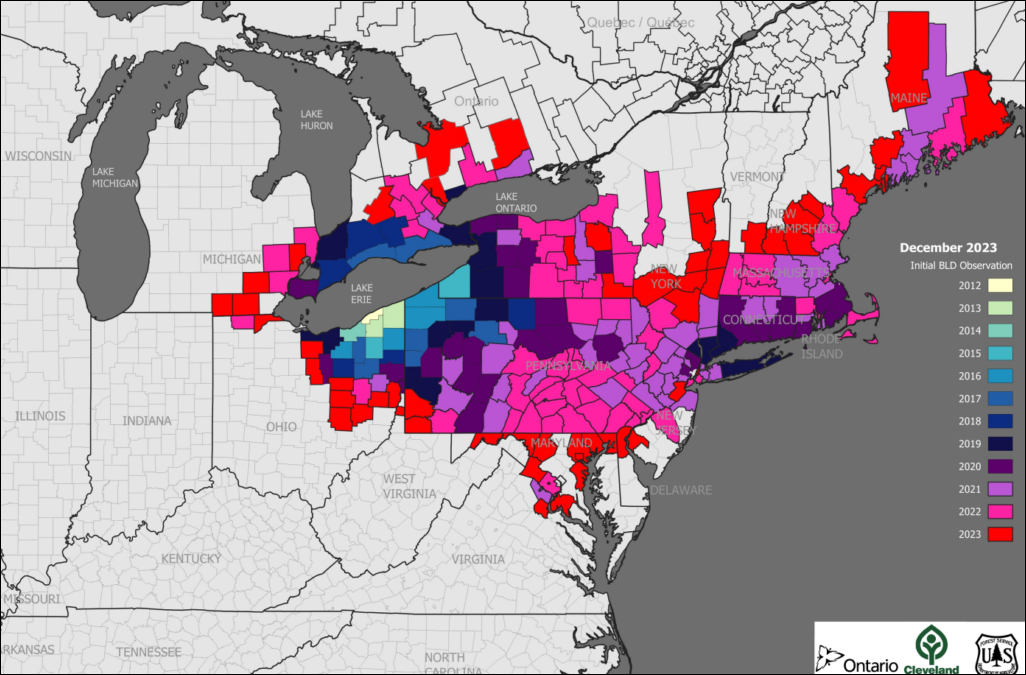
Beech leaf disease (BLD) was first discovered in North America in 2012 in Ohio. BLD has spread quickly since its arrival and is now found in several American states and Ontario. Many of these infested areas have shown noticeable changes in the canopy of beech trees with mortality occurring in many saplings as well as larger mature trees. Leading experts in the fields of forest pathology and nematology have isolated an invasive nematode that is believed to be responsible for the disease. Litylenchus crenatae ssp. mccannii is an invasive nematode that is present in the leaves and buds of infected beech trees.
Possible Impacts of BLD
Beech trees are already at risk from beech scale and beech bark disease. BLD not only causes juvenile tree mortality but also makes trees more susceptible to other pests and pathogens.
Economic Impacts
Researchers in Ohio have used an online tool to predict economic losses if half of the beech trees in the state were lost. This amounted to $225 million USD in ecosystem services such as water filtration, biodiversity maintenance, carbon sequestration, and aesthetic/recreational value (Ohio State University, 2019). Beech trees are distributed throughout the Great Lakes-St. Lawrence and deciduous forest regions of southern and central Ontario and reduced availability of healthy beech could have similar effects on Ontario’s economy.
Ecological Impacts
Beech trees are valuable nut-producing trees and provide food for many forest dwelling animals. Black bears, for example, rely heavily on beech nuts for food in northern hardwood forests. Loss of beech trees can also cause shifts in forest structure, including a loss of canopy structure, shift towards younger, smaller forests, and long-term changes to species composition (Wilke, 2019).
Social Impacts
Beech trees can grow to be beautiful, large hardwoods, and the loss of these can greatly affect aesthetic value. Canopies are large and provide dense shade. Nature enthusiasts admire the lush foliage that turns electric yellow in the fall, and the smooth gray bark that is often used as canvas (Popkin, 2018). Beech trees are found in deciduous forests and urban green spaces.
As there is still little know about BLD disease, there are no
effective control or eradication measures.
Management of BLD
As of this time, there is little information on best management practices for BLD since the transmission of this disease in not currently known. Best management practices will be updated as research on the disease continues.
Spread and Prevention
Little is known on the origins or biology of BLD, no effective control or eradication measures have been developed.
Given the small size and limited mobility of the beech leaf nematode, scientists suspect that the human movement of wood products have helped distribute this nematode. They also hypothesis that it is being distributed by the wind, small arthropods such as mites or insects, and perhaps even birds.
Management should focus on preventing the introduction of BLD and containing spread where BLD has established. More research must be conducted on determining the cause of the disease so these types of preventative measures can be developed. In general, the spread of invasive species can be prevented by restricting movement of firewood and natural wood products, conducting beech tree inventories to identify resources at risk, monitoring trees closely for signs and symptoms, increase diversity of tree species, and implement management practices to keep forests healthy.
Respond & Control
As the cause of BLD is unknown, control measures have not yet been determined. Experts have commented that affected areas should be quarantined before spread continues and the disease becomes too widespread to manage. Quarantines will prevent further spread of the disease, allowing researchers time to determine cause and effective control measures. You can help to prevent further spread of this disease by ensuring that you are not moving beech seedlings, the leaf litter from an infected area, or firewood.
adapted from Invasive Species Center - Beech Leaf Disease
More information about beech leaf disease:
· Beech Leaf Disease - NYS Department of Environmental Conservation