Introductory Lesson: Benefits of Garden-Based Learning
Course Overview
Many of us want a better understanding of how to plan, organize, and evaluate a successful garden program, yet do not know where to begin. We know that gardens, and the act of gardening, bring many benefits to youth and adults. From this desire comes the purpose of this course: to grow an understanding of how be a more effective garden-based learning educator and how to bring this knowledge to audiences in our communities.

This course focuses on the foundations and benefits of garden-based learning, and provides the tools, resources, and collaborative support needed to plan, organize and develop a successful and sustainable gardening program that fits your organization’s needs. Using a logic model approach to program development, this course is perfect for educators, program staff, volunteers, volunteer coordinators or anyone wanting to develop a community garden, school garden, or garden-based learning program for youth, adults, or people with disabilities in their local community, school, Cooperative Extension, or after school program.
Over the next few weeks, you will have the opportunity to learn from one another by engaging in group discussions, and evaluating and reflecting on the readings, research, and case studies. Garden-based learning theory will be discussed and put into practice through practicum, lesson plan assignments, and your final portfolio project. You will keep an ongoing learning journal to reflect on what you have learned and how this new information will improve your teaching practice and program planning. The instructor will take an active role by providing supportive feedback.
Contact Information
Instructor for this Course: Donna Alese Cooke
Please send any questions and messages to the instructor through Moodle.
Course Format
Before we begin the core content of the course, take time to review this Introductory week. Weekly modules open each Monday, and assignments are due the following Monday. There is an extra week built in at the end of the course for you to complete your Final Portfolio.
You can expect to dedicate approximately 5+ hours per week to the lessons, readings, discussions and assignments in this course. As a general rule, more time spent devoted to garden-based learning will help ensure that you will gain knowledge and practical proficiency. In addition to the required learning activities, we also encourage you to explore beyond the assignments and read, explore, and learn from others, whenever possible. You will occasionally find supplementary assignments and additional resources for some of the lessons.
Lastly, you will compile a portfolio which will serve as a reflection of your evolving learning experience, and a teaching "tool box" complete with real-world resources and program planning guides ready to use in for your community, school, or youth program. Please review the Course Syllabus.
Welcome! We are so glad you are a part of this course! ~Donna
About your instructor...
Donna Alese Cooke began her horticulture career in the family
nursery and landscape business, and her own businesses in floral and garden design. She is a Master Gardener, with an educational background in Landscape
Design, Childhood Education, English, Curriculum Development, and Instructional
Technology.
As Community Horticulture Specialist, Donna managed the Master Gardener Volunteers and served as advisor for many Youth, School, and Community Garden programs for Cornell University Cooperative Extension in Orange, Rockland, and Suffolk Counties, and as faculty for the University of Florida.
Donna has worked on various programs with Cornell Garden-Based Learning, including the development of the Gardening in Our Warming World: Youth Grow! curriculum and new Master Gardener Volunteer Training and Moodle courses. Other projects include online course development for the Native Plant Trust and the American Horticultural Society.
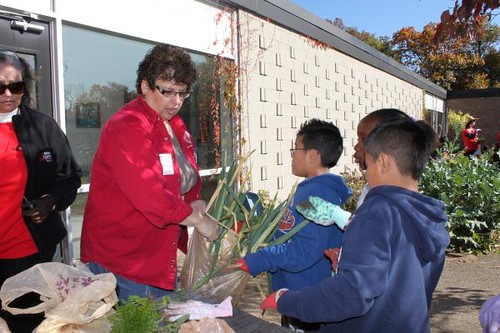
Donna and the CCE Rockland Master Gardener Volunteers at one of the school gardens participating in the USDA Peoples Garden Healthy Garden Healthy Youth Project
🪴To continue to the next page of this lesson, click on the gray button below: