Week 3 Q & A

Número de respuestas: 25

Do you have questions about this week's content? Post them here to get the answers! 

To Post Your Question:

Click on Reply and type your response in the text box. To post an image click on the Advanced link and then click on the image icon in the tool bar at the top of the text box. To post an attachment, click on the Advanced link and drag and drop your file in the attachment box. Click on Post to forum to submit your question or reply.
En respuesta a Primera publicación

Re: Week 3 Q & A

de Melissa Lazcano Prieto -
Hi everyone!

No questions about this week's content, but a somewhat related question. I have heard before that thrips might be able to spread through clothes. Wondering if this is true?

Thank you
En respuesta a Melissa Lazcano Prieto

Re: Week 3 Q & A

de John Sanderson -

Good question, Melissa.  Yes, thrips could enter the greenhouse on the clothing of workers, or in the case of retail greenhouses, on customers. This could be true of several pests of greenhouse crops, but I think that the most common pest would be spider mites. These tiny pests could be carried on clothing from infestations on houseplants or garden plants.  

En respuesta a Melissa Lazcano Prieto

Re: Week 3 Q & A

de Amy Howansky -
Hi Melissa,

Along the same lines as transporting in thrips…

I used to work at a retail greenhouse where we would get boxes of tropical plants coming in, and I also worked at a retail florist where we received boxes of cut flowers from out-of-country. In both cases, we sometimes found “bonus guests” in the plant material. We saw big, weird spiders in the cut flowers, and tiny lizards in tropical plants. Of course, the guests would always emerge on the day that we forgot to pay attention for them, so we’d get big surprises when they would scitter out onto our hand or such. One of my colleagues also found a tree toad/frog.

Then, one time I was buying native plants wholesale at a small grower operation, and I loaded some flats by my vehicle. The owner said to be careful because there were critters that could be in the flats that could travel with me. I bent to move over one more flat and a snake slithered out and scurried across the greenhouse floor and out to a nearby juniper. It had almost shared a long drive with me. Gives me the shivers still.

Amy
En respuesta a Primera publicación

Spider Plant Decline

de Tiffany Donaldson -

Hello,

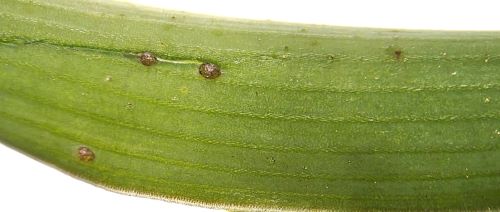
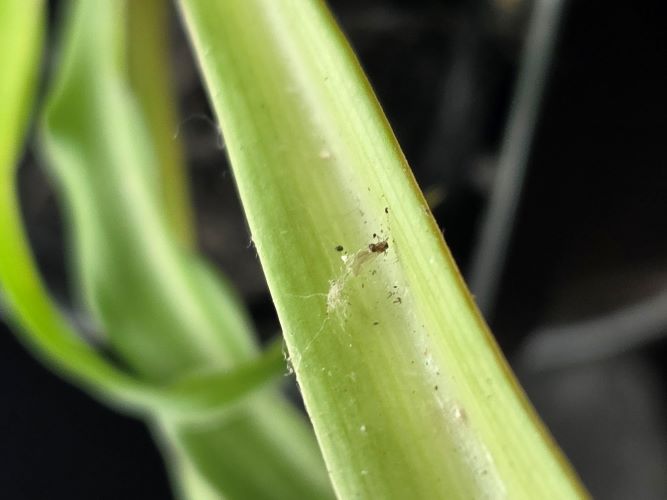
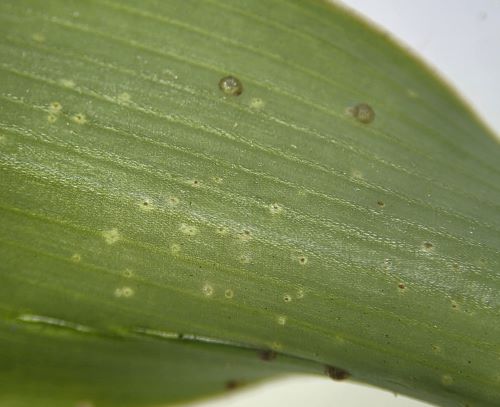
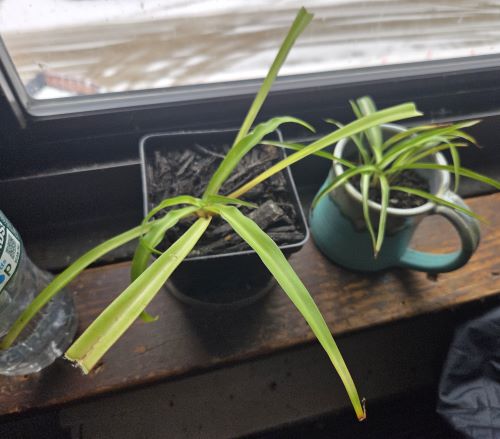
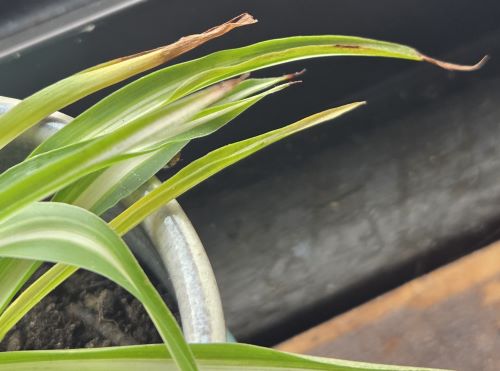
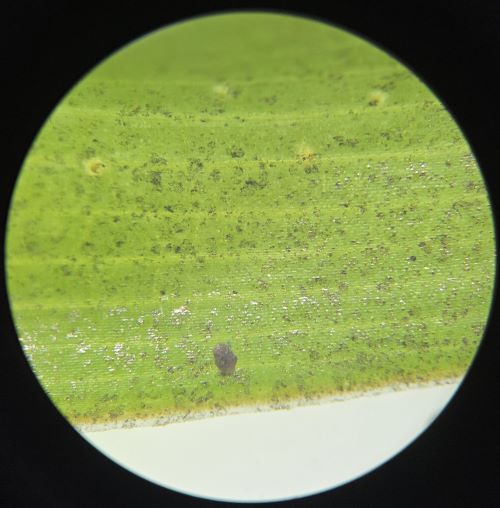
One of my coworkers has been trying to keep these spider plants alive in her office. The plant on the left is 2 years old now. They are always crawling with ladybugs and hemipterans, so I suspect that there is some sort of pest issue going on. However, when I look at the leaves under the microscope, I don't see anything. My first guess is that the predators which are constantly on the plant are eating the pest so fast they are escaping my detection. My second guess is that maybe we have not covered them in class yet. I took a photo of some of the problem areas on the leaves under a microscope. I notice a lot of brown spots near the base of the leaves (suspected frass), as well as lighter white spots with a brown center across the entire leaf. There is some 'webbing' but I am unsure if that is from the pest, if it's just dust, or a discarded spiderweb. I thought I would include it in case it is an important identifying characteristic. I also noticed some brown 'lumps' that could be pupal cases or something similar. 

Thank you!

Adjunto BrowningTips.jpg
Adjunto FecalSpotsPossibly.jpg
Adjunto UnidentifiedPest1.jpg
Adjunto UnidentifiedPest2.jpg
Adjunto UnidentifiedPest3.jpg
Adjunto WholePlant.jpg
En respuesta a Tiffany Donaldson

Re: Spider Plant Decline

de Elizabeth Lamb -
Those are small for 2 years old. Can you take a side view of the brown lumps. May be scale? If you see frass, then you should see feeding and probably enough to notice easily.
En respuesta a Tiffany Donaldson

Re: Spider Plant Decline

de Elise Schillo-Lobdell -
Tiffany, the brown bumps in the 3rd photo and at the very bottom of the 5th photo do look like scale (which we’ll cover in week 6). See if you can pick them off with your fingernail. If you can scrape them off they are probably scale, if they don’t come off or the leaf tears then they are probably not an insect. The webbing in the 4th photo could be from spider mites (which we’ll cover this week). They do make fine webbing and their webbing has a lot of ‘trash’ in it - cast skins, eggs, dead spider mites and live ones.
En respuesta a Tiffany Donaldson

Re: Spider Plant Decline

de John Sanderson -
Tiffany, Elise has a good idea about a way to check of a strange bump on a plant might be a scale insect. These don't look quite right to be scale to me, but I'm not at all confident that they're not scale. Also, the webbing in the 4th photo doesn't quite look like spider mite webbing to me either. At that magnification, I think you'd see some mites or clearer evidence of mite debris. Take a look at more leaves than just this one to see if spider mites might be present.
En respuesta a Tiffany Donaldson

Re: Spider Plant Decline

de Stephanie Burnett -
Hi Tiffany, I agree with Betsy that the spider plants look a little small for two years old. Do you know when your coworker last fertilized them? The one on the left looks a little nutrient deficient. The substrate, which looks like it might be bark heavy, may not holding water or nutrients very well. So, they could try transplanting the spider plants into something with some coir or peatmoss as one of the components. Hope this helps!
En respuesta a Stephanie Burnett

Re: Spider Plant Decline

de Tiffany Donaldson -

I wanted to thank everyone for their input on this poor spider plant.  I was able to scrape the brown spots off with my fingernail, but I am still unsure what they were. It was frequented by many brown hemipteran bugs and ladybeetles, so I was not able to see a definitive pest species. 

I did, however, find that the plant was terribly root bound, dry, and not fertilized in its 2-year lifespan. My co-worker purchased a new pot, I carefully untangled the roots, replaced the soil, and gave the plant a good wash with soapy water. I finished off the process with a little bit of fertilizer. 

I think the plant looks much happier! I will keep monitoring for pests and see if the size of the plant changes at all. 

Adjunto SpiderPlantRepot.jpg
En respuesta a Tiffany Donaldson

Re: Spider Plant Decline

de Elizabeth Lamb -

Hooray!   Thanks for being the agent, Tiffany. You have earned your green cape :) (Now everyone else in your office will be asking you for plant help.)

En respuesta a Primera publicación

Re: Week 3 Q & A

de Amy Howansky -
Hi all, ‘

This is a comment, not a question…

It was interesting to find in the reading assignments that the location examined in Ontario reported that they had more Western Flower Thrips showing up on the yellow side of the sticky card rather than the blue side. Also, I thought the self-made aspirator machine was very cool. Kids could even make one and use it for field studies for science class.

Amy
En respuesta a Amy Howansky

Re: Week 3 Q & A

de John Sanderson -
Amy, I don't think we've made it very clear that blue is just a little more attractive to Western flower thrips than yellow, but not THAT much more attractive. Doesn't surprise me to see more WFT on yellow traps than blue on occasion.
I use an aspirator all the time when I want to capture small insects without damaging them. Aspirators are very useful to entomologists. If kids are old enough to have the dexterity and patience to handle small insects, then aspirators can absolutely be useful for field studies.
En respuesta a Primera publicación

Re: Week 3 Q & A

de Ryan O'Connor -
Hello!
I have a quick question about nematodes and indoor grow lights. I know nematodes should be applied early in the morning, late afternoon, or on cloudy days because they are sensitive to UV. I'm wondering if they are also sensitive to grow lights. I don't know the specific specs of our grow lights but I have been turning them off when I apply my nematodes just to be safe. My next question would be for how long should I leave them off before it is safe to turn them back on. Thanks!

Ryan
En respuesta a Ryan O'Connor

Re: Week 3 Q & A

de Elizabeth Lamb -
Ryan,
We think this is a great comment and idea! Since we don't exactly know what the UV coming off the lights is, turning them off for an hour or so is a great idea. the nematodes will move into the soil pretty quickly.
En respuesta a Primera publicación

Re: Week 3 Q & A

de Grace Harper -
Hey everyone! This may be a silly question, but for our own records do we need to put down the exact type of thrip and quanity or just put down the whole quantity of thrips?
En respuesta a Grace Harper

Re: Week 3 Q & A

de Elise Schillo-Lobdell -
Hi Grace - NOT a silly question. So now that you have gotten the hang of IDing the most common pests on your sticky cards and recording your counts you want to start making sense of these numbers - so - either put out new cards or circle all the pests you have already counted on your cards or cross them out, whatever, just so you know you have counted them and don’t count them again. So say you have 4 cards in your house - after one week total up all the fungus gnats on all 4 cards and divide by 4 - that is your average FG/card for that house, you will now record that number (and the same for shore flies, aphids, thrips, whiteflies, whatever you decide to track) for that week, then do the same thing the following week, and the next, on & on - and that’s how you will see the trends and be able to decide when action is needed and if whatever action you took was successful. I hope this makes sense, if not please let me know and I’ll try to explain it another way {just wish I could visit everyone’s greenhouses!}. Next week Dr. Lamb is going to be talking about scouting forms and I think that will help. Also look in the resources at the various scouting forms.
En respuesta a Grace Harper

Re: Week 3 Q & A

de Elizabeth Lamb -
Grace, Some of this is determined by experience - yours as the scout and the grower's. Some thrips are really hard to tell apart and the damage on the plants may help tell you what kind it is (see answer to River, below). In some cases you might take the card to look at it more closely under a microscope to identify the thrips. And you might discuss it with the grower to see if they know or want more information. I guess the most basic answer is - if you know what types you have and can relatively quickly note numbers of different types, i would put that down. If not, get an overall number and do some more sleuthing outside of the scouting time.
En respuesta a Primera publicación

Re: Week 3 Q & A

de River Waterman -
Hello!

I think it was mentioned in class that western flower thrips are the most common greenhouse thrips, are they likely to be the only species encountered? And if there are different species present would their damage and management be mostly the same?

Thank you,
River
En respuesta a River Waterman

Re: Week 3 Q & A

de Elise Schillo-Lobdell -
John & Cheryl will give you more information but the short answer is NO, unfortunately. One point I want to make is that new species pop up and the management of them can be different (some ‘newer’ species don’t have a soil-dwelling stage - so you can’t rely on nematodes to manage them) - so you have to stay up to date on what the newest pest concerns are by attending any educational programs you can and subscribing to newsletters, trade magazines, etc. Dr. Lamb will be covering good resources next week.
En respuesta a River Waterman

Re: Week 3 Q & A

de Elise Schillo-Lobdell -
Also, some types of thrips may enter your greenhouse after a specific event - like someone mowed the grass nearby or a farm field nearby was harvested, or in late summer the weeds outside start dying - you may notice a flush of different thrips on your cards - and you’ll have to decide if they are a threat to your current crop.
En respuesta a River Waterman

Re: Week 3 Q & A

de Elizabeth Lamb -
River,
We also see onion thrips in greenhouses - on more than just onions. Canada and Florida and probably some other places have Thrips parvispinus which can give you quite different symptoms. Cuban laurel thrips in Ficus.... also different symptoms. Rarely just one type!
En respuesta a Elizabeth Lamb

Re: Week 3 Q & A

de John Sanderson -
River, you can refer to the slides I used for the thrips presentation. It shows damage by greenhouse thrips that scars the entire leaf surface. Echinothrips cause similar damage and are also black as adults. There is a slide that shows four species of thrips and they all look very similar to the naked eye. But their biologies can differ. For example, some pupate in the soil while others pupate on the plant. If you plan to target the soil-dwelling stage of a thrips species with nematodes, then you better be sure you're dealing with a thrips species that pupate in the soil. Thrips identification can be tricky and will require very high magnification. You may need to see the setae (hairs) on the thorax, or the color of the tiny ocelli (the tiny eyespots between the eyes). One of the slides provides a link to an identification key for growers to use to ID their thrips, but it requires high magnification to see the characters.
En respuesta a John Sanderson

Re: Week 3 Q & A

de John Sanderson -
So damage can be different for different thrips species. However, it seems to me that it is rare to have more than one thrips species on a plant, or maybe in the same greenhouse. Elise, how often do you see evidence of multiple thrips species in the same greenhouse, at least as far as you can identify them?
En respuesta a John Sanderson

Re: Week 3 Q & A

de Elise Schillo-Lobdell -

It seems like it is usually just Western Flower thrips for most of the year with a sprinkling of other thrips in the summer months and a random occasional poinsettia thrips that doesn’t seem related to the growing of poinsettias at all (meaning, I don’t find them any more frequently at places that grow poinsettias than ones that don’t), but most of my growers don’t have a lot of tropical/foliage plants so some types of thrips haven’t been an issue.