Week 7 Q & A

Week 7 Q & A

Week 7 Q & A

Número de respuestas: 21

Do you have questions about this week's content? Post them here to get the answers! 

To Post Your Question:

Click on Reply and type your response in the text box. To post an image click on the Advanced link and then click on the image icon in the tool bar at the top of the text box. To post an attachment, click on the Advanced link and drag and drop your file in the attachment box. Click on Post to forum to submit your question or reply.

En respuesta a Primera publicación

Re: Week 7 Q & A

de Amy Howansky -
Hi all,

I have two pictures to submit for the “stump the professors” assignment you mentioned in class. Where do I send those?

Thank you!
Amy
En respuesta a Primera publicación

Re: Week 7 Q & A

de Amy Howansky -
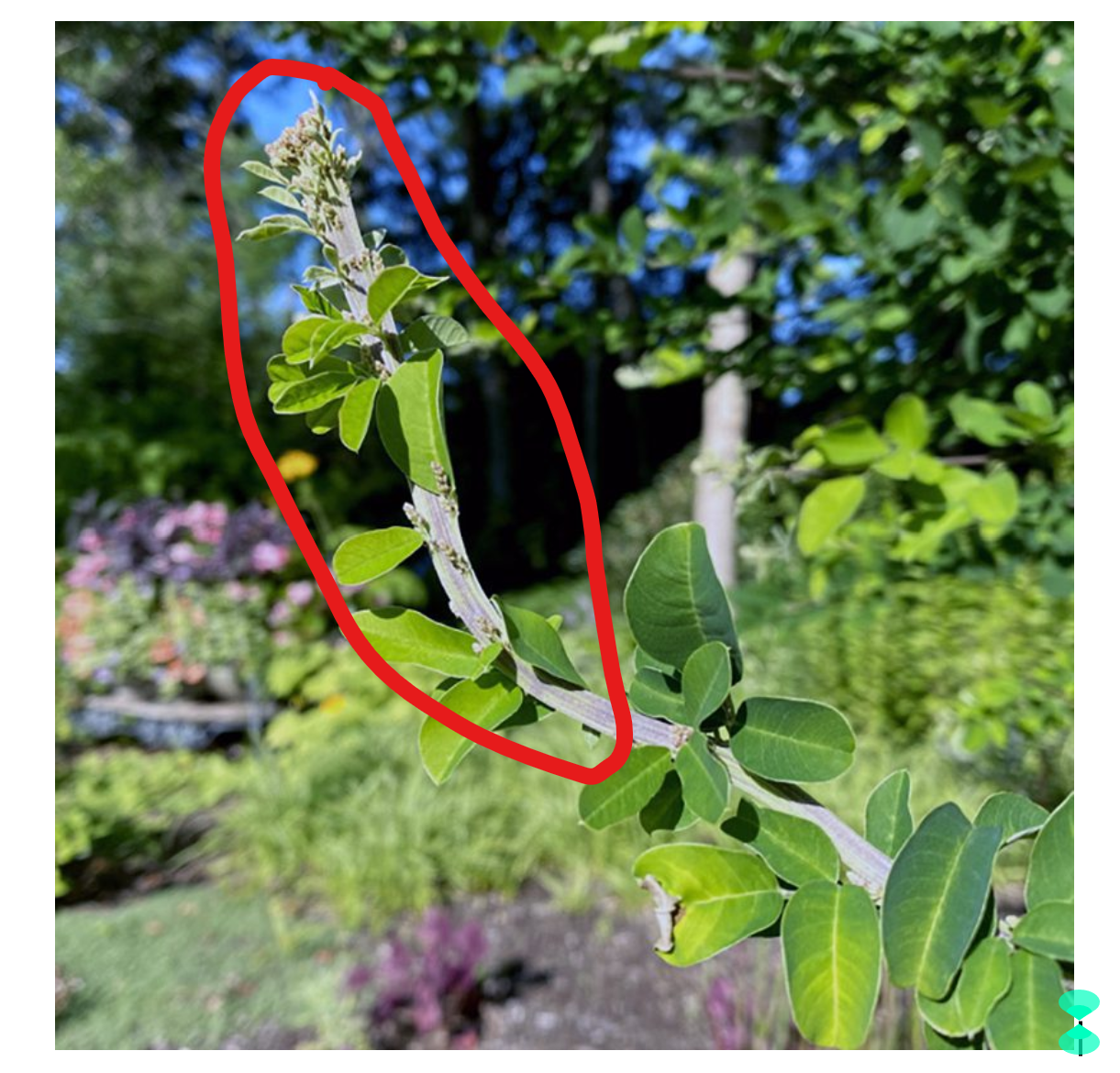
Lespedeza (bush clover) with fasciation on stem.
Hi everyone,

When reviewing the slides for this week, I noticed the Rhodococcus fasians (Leafy Gall). Is the “fasians” word-root referring to “fasciation” like sometimes seen spontaneously in the wild on flowers when they “twin” or elongate? Is the leafy gall considered an actual fasciation?

I once saw an amazing fasciation on my Lespedez (bush clover). It was very much like the pussy willows that you see with the flattened stems sometimes.

I do not have a picture of the fasciation on my Lespedeza, though. But then I was researching it and found this picture, which looks just like mine.

(Photo credit: https://www.hyanniscountrygarden.com/the-wild-and-wonderful-august-garden/fasciation-lespedeza/)

I found this “Fasciation Fascination” Facebook group referred to in an article about fasciation:
https://www.facebook.com/groups/1005513129465677

Amy
En respuesta a Primera publicación

Re: Week 7 Q & A

de River Waterman -

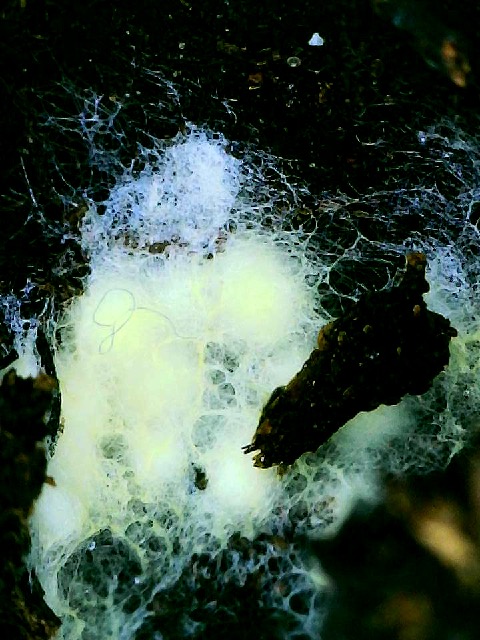
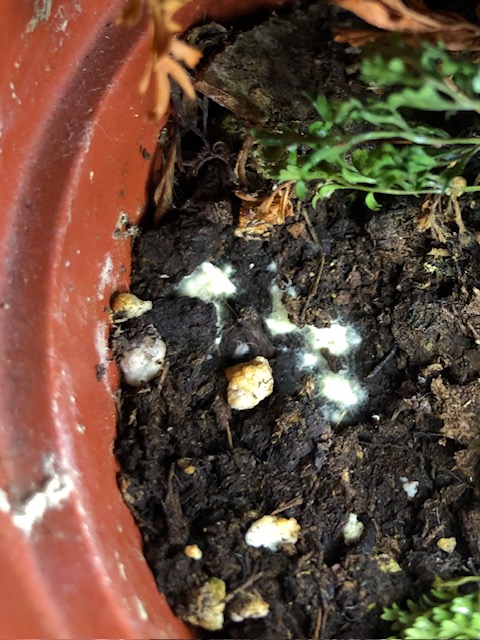
I found this little fungus growing in one of  my plants, any ideas? It looks like little fuzzy masses about ~2mm across

 fungus

up close

En respuesta a River Waterman

Re: Week 7 Q & White fungus on growing medium

de Margery Daughtrey -

Looks  like a saprophyte for sure.  If it keeps growing until you get actual mushrooms produced, and they are yellow, then it is probably Leucocoprinus birnbaumii, which appears frequently in potted plants.  The mycelium looks cottony, so I'm thinking that it is working up to producing mushrooms. See what happens.  And then pull them out before they mature to the point of having spores and spreading...they are a nuisance because the mycelium is hydrophobic, grows abundantly, and makes it hard to water the plants. 

En respuesta a Primera publicación

Week 7 Q & A

de Tiffany Donaldson -

For the last Q&A i was wondering about a pest we haven't talked about- rodents! Given the greenhouse's locations at Allegany state park, I think a large pest issue will be due to mammals getting in. I was wondering what other people's experience with this has been. I've heard some growers say that mice and rats can completely devastate greenhouse stock. Is there any other management besides blocking off possible entryways and implementing mousetraps? Our greenhouse will have roll-up sides so I'm worried there will be a high entry rate once the greenhouse is up and running. 

Thanks for any advice!

En respuesta a Tiffany Donaldson

Re: Week 7 Q & A

de Margery Daughtrey -

Hi Tiffany!

It's nice to make a clean zone around the perimeter of your greenhouse...maybe 3 feet wide. This needs to be kept free from weeds, so you would probably want weed cloth under gravel.  That creates at least a little barrier to unwanted biology. But yes, you'll still get some varmints. Mice tend to come in to eat your newly planted seeds in spring. Does anyone have a good idea for barriers to keep them from getting up onto the benches? This is like squirrel management for your bird feeder! Make it a tight, snug house... at least for winter.

Cheers, Margery

En respuesta a Tiffany Donaldson

Re: Week 7 Q & A

de Elise Schillo-Lobdell -

Hi Tiffany, I have seen a lot of rodent/animal damage over the years - mice, moles (or voles?), rabbits, groundhogs, even foxes at one place although I don’t think they ate much, mainly just poked around in the greenhouses to see if anything interested them.  Many greenhouses employ IPM kitties to handle the smaller pests.

En respuesta a Tiffany Donaldson

Re: Week 7 Q & A

de Elizabeth Lamb -
Also figuring out where they come in is important. Mice can get in through amazingly small holes. It's like they make themselves liquid.

Maybe more than you want to know about exclusion - https://cals.cornell.edu/integrated-pest-management/outreach-education/ipm-areas/community-ipm/scope
En respuesta a Primera publicación

Re: Week 7 Q & A

de Sathwik Manjunath -
What would be a cost effective and speed method for detection of Viruses and Viroids in plants for commercial operations
En respuesta a Sathwik Manjunath

Re: Week 7 Q & A

de Margery Daughtrey -

Sathwick,  There is nothing that will give you all the answers. If you identify your most important crop, and find out what are the most serious viruses currently affecting that crop, then in some cases you can go to Agdia, Inc and obtain immunostrips to test for those viruses.  With most ornamental businesses, your main interest would be INSV or TSWV - they are both really common because they are spread by thrips, which are very commonly problematic. It would probably not be cost effective for you to get additional tests to have on hand, because these tests, although quick, cost something like $12 apiece. If you have a non-resistant tomato crop, you might instead want to bring in TMV immunostrips.  If you specialized in petunias, you might also want to be able to test for TMV.  Rather than going this route, you could simply send a sample to Agdia for testing in their lab - more expensive, but they can test for many more viruses in one test, and give you a lot more information than the +/- for one virus that you can get from an immunostrip. Testing decisions are based on the value of your crop and the size of your greenhouse business.  For most growers who finish crops for final sale, I think it is fine to wait for symptoms and then ask the question of what virus is present, perhaps with the help of an extension person or consultant.  Other things can mimic virus symptoms, especially some nutrient deficiencies and herbicide injury.  It's generally too expensive to test a healthy looking crop just to see if there is a virus lurking within it.
En respuesta a Primera publicación

Re: Week 7 Q & A

de Ryan O'Connor -
Hello!
I have a procedural question regarding plant inspections. So I suppose this question is for Elise! I was reading the IPM book that came with the course and they mentioned two different ways for inspecting plants (although it may be a six to one, half dozen to the other situation). They first said that for an area of 1,000 sq. ft. you should stop at 10-20 locations but gave no information on how many plants to randomly inspect at each location. Then, later in the book they say that you should inspect 10-20 plants for every 1,000 sq. ft. but gave no information on how many locations this should be broken up into. Now, I know every situation is unique and the exact procedure will probably depend on how many plants are in the greenhouse, how many cultivars, how the plants are grown, etc. but I was wondering if there is an industry standard for how many locations/plants to inspect in a given area. For example, lets say you have a 5,000 sq. ft. greenhouse, so maybe you'll decide you want to stop at 50 locations, making sure you inspect every type of cultivar in the greenhouse, and at each location you'll randomly inspect three plants, so totaling 150 plants that you'll inspect in that greenhouse. Is that generally how you might go about making a plant inspection plan? My apologies if this question has already been covered. I haven't been able to keep up with all the Q&A forums.

Ryan
En respuesta a Ryan O'Connor

Re: Week 7 Q & A

de Elise Schillo-Lobdell -

Random thoughts in no particular order, hope this helps:  I am imagining that the person who wrote that was thinking of scouting a greenhouse of all one crop and probably one size of that plant - say a standard 6 1/2” poinsettias growing on benches.  So lifting up and scouting 10-20 plants per 1,000 square ft. would seem like a good amount to scout in the earlier weeks/months of the crop.  At each stop if I found an infested plant I would scout more in that same area to determine the extent of the infestation - so it would be only one plant inspected unless I found something on that plant - but maybe 10 plants scouted if I kept finding more pests.  In that case I would be marking off the area with flagging tape.  After finding several highly infested areas in one house there really is no point in continuing to scout that house - it needs to be dealt and me counting 5,000 more whiteflies isn’t going to make that happen any faster.  Conversely, if a house continues to be clean week after week and the cards are clean, then I would move more quickly through the house and probably lift up way fewer than 10 per 1,000 sq. ft.  Also, as the crop get bigger and there is more chance of breakage I would definitely pick up fewer plants.  There is a video of me in a house with very large poinsettias growing on the floor.  That house is probably at least 5,000 sq.ft., the plants were very clean, and VERY heavy.  I usually scouted about  15 of them each week.  With mum plants that big I would often just turn over leaves to check for spider mites and then shake some of the plants and sort of thump the plant down hard to see if any caterpillars fell out.  Depending on what the surface is they are growing on you can usually see the caterpillar frass, but knocking the plants dislodges the little caterpillars even before there is much frass.   So all the above would be for houses with mono cultures and medium to large sized pots.  If it was a mono-culture of something that has very few pest problems - say an entire house of petunias or an entire house of zonal geraniums - then I pretty much would just be looking for disease or nutritional problems and relying on the cards to alert me to any pests.  I would walk up and down every aisle looking at all the plants - looking for any signs of pest damage , cast skins, honeydew, etc. - but not actually lifting up individual plants  unless there was something like a yellow spot that needs closer inspection.  Ivy geraniums are a whole different story - they require very close inspection of the growing tips for thrips and later in the season spider mites.  The shaking thing is also good for Boston ferns & any ferns that get caterpillars. And then I also want to say that there is the ideal and there is the reality.  If a grower is paying you by the hour to scout you have to find out how many hours they are willing to pay for and then you have to complete the job in that amount of time.  They probably aren’t going to pay for you to find every last infested plant in the place.  Sometimes in my notes to the grower I would have to say “there are aphids in house four but I didn’t find the source”.   Yes I could have found them if I spent two more hours in there but it was probably more valuable to the grower if I got all the other houses scouted that week.  I may adds more thoughts later.

En respuesta a Primera publicación

Re: Week 7 Q & A

de Grace Harper -
Not really a question about this weeks material, but what do y'all do to get rid of the casts that aphids leave behind. We had an green peach aphid explosion on our calibrachoa baskets. We sprayed them and I do not see anymore live ones, but the casts are everywhere and water is not rinsing them off. What can I do to get rid of them so customers don't worry?
En respuesta a Primera publicación

Re: Week 7 Q & A

de Grace Harper -
I have something on some what I thought was some kind of mold on a few dahlias. It's only one variety it's affecting and I thought it weird.
Adjunto httpslh3.googleusercontent.compwAP1GczMmuvtHsmtUsNgEuIPrSzl1YhcuznqpE-55egEqDHVO8I-k7ZWaqCSw_n_X-NG5yrL6gWiuZx3qn3bp029hHysS9L9JYs59ot8ise_R-TTHxXMkk3w=w54-h72-no
En respuesta a Grace Harper

Re: Week 7 Q & A

de Margery Daughtrey -
Hi Grace! That's a teensy-weensy photo, but it looks so cottony that I think it could be egg masses of mealybugs. Powdery mildew doesn't get all that fluffy on dahlias. On euonymus, yes, but dahlias would be more likely to have a thin film of white fungal mycelium.
En respuesta a Primera publicación

Re: Week 7 Q & A

de Ana Gourlay -
Are there any beneficial nematodes that will parasitize or out compete "bad" nematodes?
Also, we're getting to the time of year when a lot of gardeners dig up and swap plants. Here in NH, to prevent the spread of jumping worms, it is recommended that things are moved bare root. Is there a root dip that would work best for disinfecting the roots from common pests and diseases?
En respuesta a Ana Gourlay

Re: Week 7 Q & A

de Elizabeth Lamb -

There are some predatory nematodes that attack plant feeding nematodes - although i don't know that any are commercially available.  More information on managing damaging nematodes than you probably wanted - https://attra.ncat.org/publication/nematodes-alternative-controls/#:~:text=Nematode%20control%20is%20essentially%20prevention%2C%20because%20once,matter%20to%20support%20diverse%20populations%20of%20microorganisms.


And i haven't heard of any dips that work for getting jumping worms off roots beyond water.


Thanks, Ana!


En respuesta a Ana Gourlay

Re: Week 7 Q & A

de Margery Daughtrey -
Agree with Betsy - although such anti-nematode nematodes exist, they aren't commercially available. There are also anti-nematode fungi and no doubt bacteria, but since these aren't commercially available either you best recourse is to use a nice rich compost in garden situations that will contain a lot of beneficial organisms. Adding just a little compost to an otherwise 'clean' peat mix in the greenhouse production is, however, risky....because you might be adding pathogens at the same time that could prevail in the soilless mix. Jumping worm preventive practices are all that can be done safely or feasibly when moving plants. I can't imagine a group of gardeners wanting to dip into something toxic as they collect new plants. There's no such treatment registered, either. Those who add new plants to their garden should make sure they don't see ugly symptoms on the roots, and should take care not to over-water (or under-water) or over fertilize when they get them home!